
Due To or Do To: Which Is Correct?
Due to or do to — which one is correct? The two phrases sound exactly the same when you speak, but they do completely different jobs in a sentence. “Due to” means caused by or because of: “The match was cancelled due to rain.” “Do to” is the verb do followed by the word to, used when someone performs an action on a person or thing: “What did they do to the car?”
In this guide, you will learn the meaning of each phrase, the simple test that always tells you which one to use, lots of example sentences, the common mistakes to avoid, and easy tricks so you never confuse them again. People also ask the question the other way round — do to or due to — and look up the due to or do to meaning; it is the same puzzle, and both orders are answered here.
The Short Answer
- Use due to when you mean caused by / because of — it gives a reason. “The delay was due to traffic.”
- Use do to only when do is the main verb of the sentence and an action is done to someone or something. “What did you do to your hair?”
Ask yourself one question: Am I giving a reason, or describing an action? Reason → due to. Action → do to. That single question solves nearly every case.
What Does “Due To” Mean?
Due to means caused by or because of. It explains why something happened. According to the Merriam-Webster entry for “due to”, the phrase is used in the sense of “because of” — it points to the cause of something.
The Grammar Behind “Due To”
Traditionally, “due to” works as an adjective phrase. It describes a noun and usually comes after a form of the verb be (is, was, were, seems):
- “The cancellation was due to bad weather.” (What caused the cancellation? Bad weather.)
- “His success is due to hard work.”
- “The problem seems due to a software error.”
In modern English, people also use “due to” at the start of a sentence, like “because of”: “Due to the storm, the school closed early.” Strict traditionalists once disliked this use, but today it is accepted everywhere in normal writing and speech. In very formal writing, you can always choose the safest pattern: put “due to” after a form of “be.”
Quick Test for “Due To”
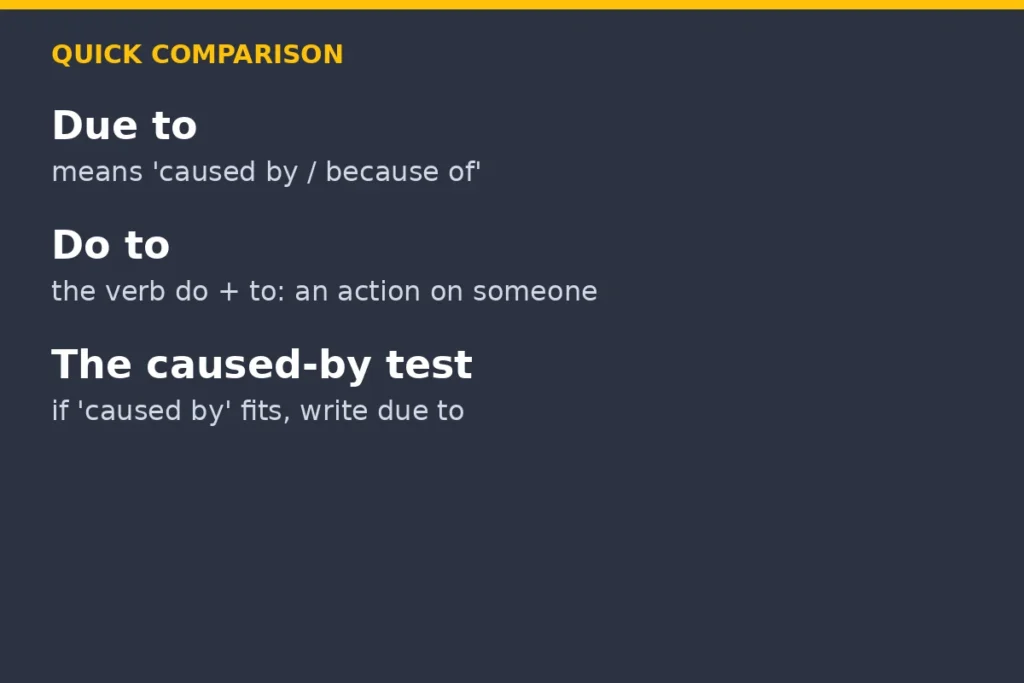
Replace “due to” with “caused by.” If the sentence still makes sense, “due to” is correct:
- “The delay was due to fog.” → “The delay was caused by fog.” ✔ Makes sense.
- “What did you do to the door?” → “What did you caused by the door?” ✗ Nonsense — so this sentence needs “do to.”
Examples of “Due To” in Sentences
- The flight was delayed due to strong winds.
- Her headache was due to lack of sleep.
- Due to heavy rain, the picnic was moved indoors.
- The shop closed early due to a power cut.
- His absence was due to illness.
- The road is closed due to an accident.
- Tickets sold out quickly due to high demand.
- The crop failed due to the long drought.
- She missed the train due to traffic.
- The meeting was cancelled due to bad weather.
What Does “Do To” Mean?
Do to is not a fixed phrase like “due to.” It is simply the verb do standing next to the preposition to. It appears when an action is performed on someone or something — often in questions like “What did you do to…?” or in patterns like “have something to do to…” and “do something to someone.”
- “What did the mechanic do to fix the car?”
- “I don’t know what the heat did to my phone battery.”
- “Look what the cat did to the curtains!”
Notice that in every “do to” sentence, you can point to an action and a receiver of that action. If there is no action, “do to” is almost certainly wrong, and you need “due to.”
Common “Do To” Patterns
- What did you do to + noun? “What did you do to your ankle?”
- Do something to someone/something: “Don’t do that to your brother.”
- Have work to do: “There is a lot to do to prepare the house” — here “do” is an action verb, so “do to” is right.
Examples of “Do To” in Sentences
- What did you do to make the soup taste so good?
- He asked what the dentist would do to his tooth.
- See what the rain did to my new shoes!
- We still have a lot to do to finish the project.
- What have they done to this room? It looks wonderful.
- She wondered what the medicine would do to her body.
- Please don’t do anything to the computer settings.
- What did the storm do to the old bridge?
Quick Comparison: Due To vs Do To
| Point | Due To | Do To |
|---|---|---|
| Meaning | Caused by / because of | Perform an action on someone or something |
| Job in the sentence | Gives a reason (adjective phrase) | Verb “do” + preposition “to” |
| Answers the question | “Why did it happen?” | “What action was done?” |
| Test | Replace with “caused by” — if it works, it is right | Replace “do” with another action verb (fix, say) — if it works, it is right |
| Example | The delay was due to fog. | What did you do to the lock? |
| How common? | Very common, every day | Much less common |
Due To and Do To in Different Contexts
Formal Writing, News, and Exams
“Due to” is at home in reports, news, and exam answers: “The increase in prices is due to higher fuel costs.” Examiners treat “do to” in a reason sentence as a clear spelling-of-meaning error, so this pair is worth learning well.
Work Emails and Official Notices
Offices use “due to” constantly: “Due to maintenance, the office will be closed on Friday.” One warning: avoid the wordy phrase “due to the fact that” — simply write “because”: “The office closed because the pipes froze.”
Everyday Speech and Questions
“Do to” lives mostly in spoken questions: “What did you do to your hair? It looks great!” In casual speech you will rarely say “due to” — “because of” and “thanks to” sound more natural: “We were late because of the bus.”
Warnings and Complaints
“Do to” often appears when something has been damaged or changed: “Look what the children did to the wall!” The phrase carries the feeling that someone acted on something — for better or worse.
“Due” vs “Do”: The Root Words
The whole difference grows out of two small words:
- Due is connected with owing, expecting, and causing. A bill is due (owed); a train is due (expected); a result is due to a cause.
- Do is the great action verb of English: do homework, do a job, do your best.
So think: due = reason, do = action. If your sentence is built around a reason, the “due” family is waiting. If it is built around an action, choose “do.”
Synonyms and Alternatives for “Due To”
To avoid repeating “due to” in every sentence, English gives you several natural alternatives:
- Because of — the most common everyday choice: “We stayed home because of the rain.”
- Owing to — slightly formal, same meaning: “Owing to illness, the singer cancelled the show.”
- As a result of — clear and formal: “Flights were cancelled as a result of the strike.”
- Thanks to — for positive causes: “Thanks to your help, we finished on time.”
- Because + a full sentence — “Because it rained, the match stopped.”
Why People Confuse Due To and Do To
The main reason is sound. In American English, “due” and “do” are pronounced exactly the same (/duː/). In British English, “due” often keeps a small “y” sound (/djuː/), but in fast speech the difference almost disappears. Because your ears cannot guide you, your brain writes the word it knows best — usually “do” — and the mistake is born. Sound-alike pairs cause many English errors; our guide to sale vs sail explains another famous pair.
A second reason: “do to” really exists. Because both phrases are correctly spelled, the wrong choice does not look wrong on the page. And a third reason is speed: people write the words in the order they hear them in their head, without stopping to check the meaning.
Common Mistakes to Avoid
- Writing “do to” for a reason: ✗ “The game was cancelled do to rain.” → ✔ “The game was cancelled due to rain.”
- Writing “due to” for an action: ✗ “What did you due to the car?” → ✔ “What did you do to the car?”
- “Due to the fact that”: ✗ Wordy and heavy. → ✔ Use “because”: “We left early because we were tired.”
- Starting a casual message with “due to”: It is correct but stiff. In friendly writing, “because of” usually sounds better.
- Trusting spellcheck: ✗ “The delay was do to snow” passes most spellcheckers. → ✔ Only the meaning test catches this error.
Why Spellcheckers and Grammar Tools Miss This Mistake
Most grammar tools check spelling first and meaning second. Because “do” and “due” are both real words, and “do to” is a real combination, many tools accept the wrong sentence without a warning. Newer tools catch some cases by looking at context, but they are not reliable here. Your own test — reason or action? — is still the safest checker.
Tricks to Remember
- Reason vs action. The master rule: “due to” gives a reason; “do to” describes an action.
- The “caused by” swap. If “caused by” fits in the sentence, choose “due to.”
- The action-verb swap. If you can change “do” into another action verb (fix, tell, show) and the sentence still works, choose “do to”: “What did you say to him?” ✔ action.
- Due = oWeD. “Due” is about what is owed or caused — the letter pattern u-e belongs to the reason word; the short “do” belongs to action.
- No action, no “do to.” If nobody is doing anything in the sentence, “due to” is almost always the answer.
Self-Check Quiz
- The train was late ______ (due to / do to) a signal problem.
- What did the hairdresser ______ (due to / do to) your hair?
- His sore throat was ______ (due to / do to) shouting at the match.
- There is still a lot to ______ (due to / do to) before the guests arrive.
- ______ (Due to / Do to) the roadworks, we took a different street.
- Look what the dog ______ (due to / do to) my shoes!
Answers: 1. due to (a reason: the signal problem caused the delay) 2. do to (an action by the hairdresser) 3. due to (a reason) 4. do to (“do” is the action verb — work to perform) 5. Due to (a reason at the start of the sentence) 6. do to (the dog performed an action on the shoes).
Frequently Asked Questions
Is it “due to” or “do to”?
For a reason or cause, it is always “due to”: “The delay was due to fog.” Use “do to” only when “do” is the action verb of the sentence: “What did you do to the car?” If you are giving a reason, “do to” is wrong.
Can “do to” ever replace “due to”?
No. The two phrases have different meanings and different grammar jobs. “Do to” can never give a reason, and “due to” can never describe an action. Swapping them always creates an error.
What is the difference between “due to” and “because of”?
They mean the same thing. Traditionally, “due to” works like an adjective after a form of “be” (“The delay was due to fog”), while “because of” works like an adverb (“We stopped because of fog”). In modern everyday English, both are used in both places, and nobody will object.
Is “due to” formal or informal?
It works in both, but it feels slightly formal. In reports, emails, and exams it is perfect. In friendly speech, “because of” and “thanks to” sound warmer and more natural.
Why do people confuse “due to” and “do to” so often?
Because they sound the same (or nearly the same) when spoken, and both are correctly spelled, so spellcheckers rarely warn you. Writers choose by sound instead of meaning — and meaning is the only safe guide here.
How can I check my sentence quickly?
Do the “caused by” test: replace the phrase with “caused by.” If the sentence still makes sense, use “due to.” If it becomes nonsense, your sentence describes an action — use “do to.”
Final Conclusion
Due to or do to comes down to one simple idea: reasons take “due to,” actions take “do to.” “Due to” means caused by and explains why something happened; “do to” is the action verb “do” plus “to,” used when someone acts on a person or thing. When you are unsure, swap in “caused by” — if it fits, you have your answer. Learn this one test, and this common mistake will disappear from your writing. Keep building your accuracy with our guide to neither vs either and other confusing word pairs.