Neither vs Either: Meaning, Usage, and Key Differences Explained
The pair neither vs either confuses learners at every level, because the two words look similar, sound similar, and appear in the same kinds of sentences. Yet their meanings point in opposite directions: either opens a choice, and neither closes both choices.
This guide explains both words in simple English, with a clear comparison table, grammar rules, plenty of examples, and a special section on the famous “me either” or “me neither” question.
Neither vs Either: Key Differences at a Glance
| Feature | Either | Neither |
|---|---|---|
| Core meaning | One of two (any one); also “both” | Not one and not the other; none of two |
| Feeling | Positive / a choice exists | Negative / no choice works |
| Pair partner | either … or | neither … nor |
| Verb after it (alone) | Singular: “Either is fine.” | Singular: “Neither is fine.” |
| Example | You can take either bus. | Neither bus goes to the airport. |

What Does “Either” Mean?
Either is a flexible word with four jobs in English. Its main meaning is “one or the other of two things.”
1. Either as a Determiner
Before a singular noun, meaning one of the two: “You can sit on either chair.” / “Either day works for me.”
2. Either as a Pronoun
Alone or with “of,” meaning one of the two: “Either is correct.” / “I do not like either of the songs.”
3. Either as a Conjunction
In the pair either … or, it presents two options: “Either we leave now, or we miss the train.”
4. Either as an Adverb
In negative sentences, either means “also not”: “I cannot swim, and my brother cannot either.” Either can also mean “both” in a few cases: “There were trees on either side of the road” means on both sides.
Pronunciation note: either has two accepted pronunciations — “EE-ther” (/ˈiːðər/), common in American English, and “EYE-ther” (/ˈaɪðər/), common in British English. Both are correct. Neither follows the same pattern: “NEE-ther” or “NYE-ther.”
What Does “Neither” Mean?
Neither means “not the first one and not the second one.” It is the negative partner of either. If either says “one of the two,” neither says “zero of the two.”
- Determiner: “Neither answer is right.”
- Pronoun: “Neither of them called me.”
- Conjunction: In the pair neither … nor: “She neither smiled nor spoke.”
- Adverb (in short replies): “I do not like it.” — “Neither do I.”
You can check the full dictionary treatment in the Cambridge Dictionary entry for either, which lists these same uses with examples.
When to Use Either vs Neither: A Simple Decision Guide
When you wonder when to use either vs neither, ask one question: is a choice open, or are both choices closed?
- If one of the two is possible or true → use either. (“Either shirt looks good.”)
- If both are impossible or untrue → use neither. (“Neither shirt fits me.”)
- In a negative sentence where you mean “also not” → use either at the end. (“He did not call, and she did not either.”)
- To agree with a negative statement → use neither. (“I do not like tea.” — “Neither do I.”)
Grammar Rules: Subject–Verb Agreement
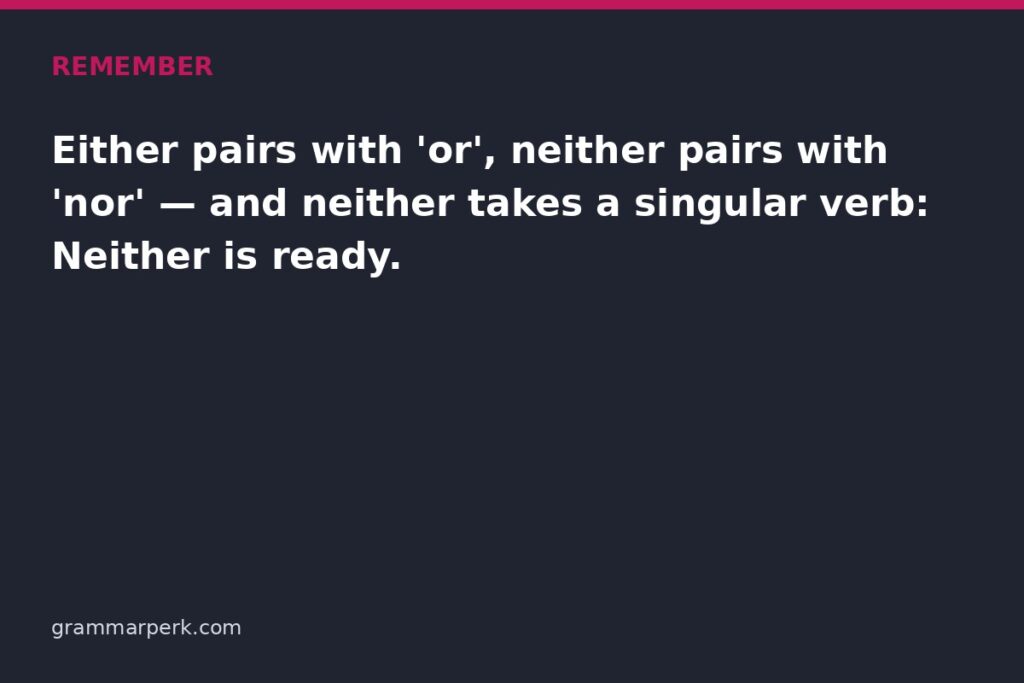
This is the rule learners break most often. When either or neither stands alone as the subject, or comes before a singular noun, use a singular verb:
- ✅ Either of the answers is correct.
- ✅ Neither of the students was late.
- ✅ Neither road leads to the beach.
With the pairs either…or and neither…nor, the verb agrees with the nearer subject (the one closest to the verb):
- Neither the teacher nor the students were ready. (students is nearer → plural)
- Neither the students nor the teacher was ready. (teacher is nearer → singular)
- Either you or your friends are wrong.
In very casual speech, people sometimes use a plural verb after “neither of + plural noun” (“Neither of them are here”), but in exams and careful writing, the singular verb is the safe, correct choice.
Either … Or vs Neither … Nor
| Pair | Meaning | Example |
|---|---|---|
| either … or | One of the two will happen/be chosen | Either take the bus or walk. |
| neither … nor | Both are excluded | He neither called nor messaged. |
Two warnings: never mix the pairs (“either … nor” and “neither … or” are wrong), and remember that neither already carries the negative meaning, so do not add another “not”: “He neither called nor wrote,” not “He did not neither call nor write.”
“Me Either” vs “Me Neither”: Which Is Correct?
The me either vs me neither debate is one of the most common questions in spoken English. A friend says, “I don’t like waking up early,” and you want to agree. What do you say?
The standard, grammatically safe answer is “Me neither.” The statement is negative (“don’t like”), so the agreement must be negative too — and neither is the negative word. You can also say “Neither do I,” which is the most formal and always correct.
So where does “me either” come from? It is a very common informal shortcut in American speech, probably a short form of “Me either” from patterns like “I don’t, either.” Millions of native speakers say it, and nobody will misunderstand you. But teachers, exams, and careful speakers prefer “Me neither.” Our advice: use “Me neither” when you want to be correct, and do not worry if you hear “me either” in movies and daily talk.
Examples in Sentences
Either
- You can take either road; both lead to the station.
- Either of the two books is fine for the exam.
- I do not drink coffee, and I do not drink tea either.
- Either you pay now, or you pay a fine later.
- There are shops on either side of the street.
Neither
- Neither answer is correct; try again.
- Neither of my brothers lives in this city.
- “I have never seen snow.” — “Neither have I.”
- Neither the rain nor the cold stopped the match.
- She neither eats meat nor drinks milk.
Common Mistakes to Avoid
- ❌ “Neither of the boys are tall.” → ✅ “Neither of the boys is tall.”
- ❌ “I do not like it neither.” → ✅ “I do not like it either.” (One negative per idea.)
- ❌ “Either take tea nor coffee.” → ✅ “Either take tea or coffee.”
- ❌ “Neither he nor his brother were there.” → ✅ “Neither he nor his brother was there.” (The nearer subject, brother, is singular.)
- ❌ Using either/neither for three things. For three or more, use “any” and “none”: “None of the three plans works.”
Tips to Remember
- Either = open door: one of two choices is possible.
- Neither = both doors closed: it starts with “n,” like “no” and “not.”
- Pairs stay together: either with or, neither with nor.
- Agreeing with a negative? Use neither: “Neither do I.”
Quick Self-Check Quiz
- ______ of the two keys opens the door. They are both the wrong keys. (Either / Neither)
- “I cannot speak French.” — “______ do I.” (Neither / Either)
- Either the cat or the dogs ______ making that noise. (is / are)
Answers: 1. Neither 2. Neither 3. are (the nearer subject, dogs, is plural)
Frequently Asked Questions
What is the difference between neither and either?
Either means one of two things — a choice is open. Neither means not one and not the other — both choices are closed. Compare: “Either dress is fine” (both are OK, pick one) and “Neither dress fits” (both are wrong for me).
Is it “neither is” or “neither are”?
In careful English, “neither is.” Neither is treated as singular when it is the subject: “Neither is ready.” You will hear “neither are” in casual speech before plural nouns, but the singular is the exam-safe form.
Can either also mean “both”?
Yes, in a special use: “on either side” and “in either hand” mean both sides and both hands. This meaning appears with things that come in pairs, like sides, ends, and hands.
How do you pronounce either and neither?
Either can be “EE-ther” or “EYE-ther”; neither can be “NEE-ther” or “NYE-ther.” All four are accepted. Pick one style and stay consistent.
Can I use neither for more than two things?
Traditionally, no. Neither and either are for two things only. For three or more, use “none” and “any”: “None of the four buses stops here.”
Which is correct in exams: “me either” or “me neither”?
“Me neither” is the correct choice for exams and formal English, because the first statement is negative. “Me either” is informal speech only.
Final Conclusion
The whole either vs neither question comes down to one picture: either opens one of two doors, and neither closes both. Keep the pairs together (either…or, neither…nor), use a singular verb when either or neither is the subject, and answer negative statements with “Neither do I” or “Me neither.” With these habits, you will use both words correctly every time.
Ready for more confusing-word guides? Continue with assume vs presume vs infer, a trio that traps even advanced learners, and annual vs yearly vs every year, another everyday choice made simple.