Should You Say “Thanks a Lot”? Is It Polite or Sarcastic?
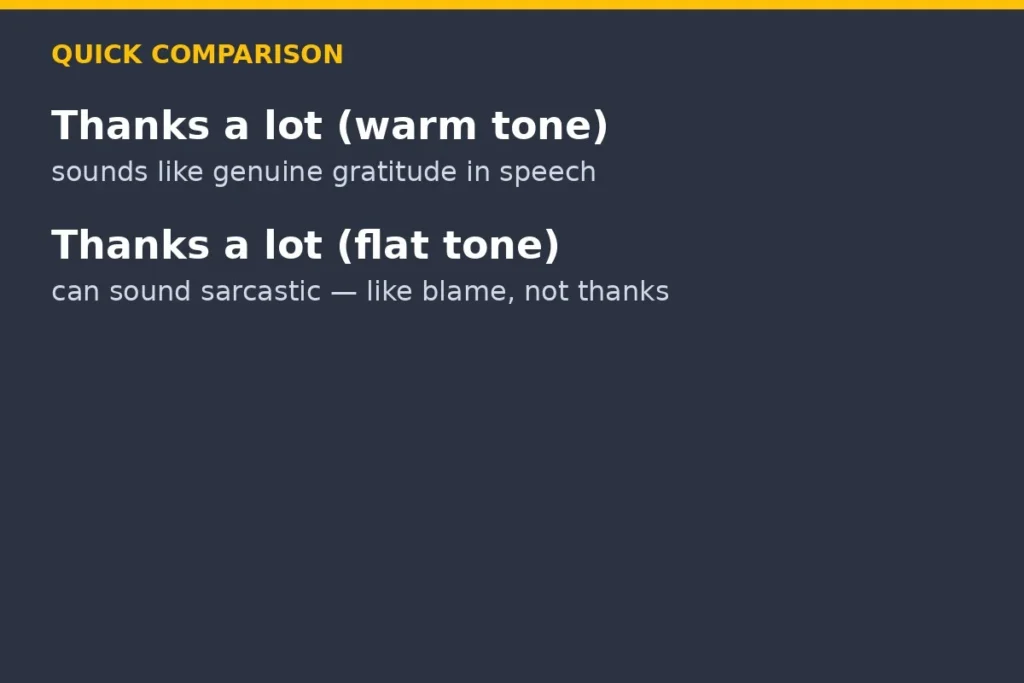
Should you say “thanks a lot”? The short answer is: yes — it is polite and friendly when you say it warmly after real help. But it is a risky phrase. Said with a flat voice, or written in the wrong situation, the same three words can sound sarcastic, as if you are annoyed instead of grateful. With “thanks a lot,” the words matter less than the tone.
In this guide, you will learn what “thanks a lot” really means, when it sounds genuine, when it sounds sarcastic, how it behaves in speech and writing, safer alternatives for formal situations, and tips for expressing gratitude naturally.
What “Thanks a Lot” Really Means
At its core, “thanks a lot” is a strong thank-you. It is used everywhere — in shops, offices, homes, and messages — and most of the time it is completely sincere.
The Literal Meaning
Look at the words one by one. “Thanks” means gratitude, and “a lot” means a large amount. So “thanks a lot” literally means “a large amount of thanks” — it is the casual cousin of “thank you very much.”
- “Thanks a lot for your help with the bags.”
- “Thanks a lot for coming today.”
Nothing in the words themselves is rude; problems start only when the situation or the delivery sends the opposite signal.
Why the Same Words Can Sound Sarcastic
English speakers love irony — saying the opposite of what they mean. Because “thanks a lot” is strong and emphatic, it became a favourite tool for ironic thanks: gratitude words used when someone has actually made your life harder. The Cambridge Dictionary entry for “thanks a lot” lists both uses side by side: a way of thanking someone, and an ironic use for when someone “has done something that has made your life more difficult.” Listeners decide which one you mean by your tone — and by whether anything good actually happened.
When “Thanks a Lot” Sounds Genuine
“Thanks a lot” sounds sincere when everything around the words supports them. Look for these signs:
- Something good really happened: the person helped you, gave you something, or solved a problem.
- A warm, rising voice: energetic, not flat or heavy.
- A smile and eye contact face to face.
- Extra details: you say what you are thankful for — “Thanks a lot for staying late to help me finish this.”
Real-Life Scenarios Where It Works Perfectly
- A friend helps you move house: “Thanks a lot — I could never have done this alone.”
- A colleague finishes a report early: “Thanks a lot, that really saved us.”
- A neighbour waters your plants while you travel: “Thanks a lot! The garden looks great.”
- Your teacher explains a difficult topic again, slowly: “Thanks a lot, I finally understand it now.”
In all of these, the positive situation and warm delivery make the meaning unmistakable.
When “Thanks a Lot” Sounds Sarcastic
Now turn the situation around. Something went wrong, you are frustrated, and the “thanks” comes out anyway. That is when “thanks a lot” turns sarcastic:
- “Oh, thanks a lot for telling me at the last minute.” (said angrily)
- “Thanks a lot. Now the whole file is deleted.”
- “You ate the last slice? Thanks a lot.”
The Signs of the Sarcastic Version
- A flat or slow voice, often with heavy stress on the word “lot”: “Thanks a LOT.”
- No details, no smile — sometimes an eye-roll instead.
- “Oh” in front of it: “Oh, thanks a lot” is a classic sarcasm signal.
Why It Feels Passive-Aggressive
Sarcastic thanks feels passive-aggressive because the words and the feelings fight each other. The listener hears polite words but senses a complaint underneath, and people naturally trust the feeling more than the words. This mismatch is also why “thanks a lot” is risky for learners: if your delivery is a little flat, listeners may hear the sarcastic version even when you mean the kind one — just as mixing up words like sale vs sail can send the wrong message.
Quick Comparison: “Thanks a Lot” vs Other Ways to Say Thank You
| Phrase | How It Usually Sounds | Sarcasm Risk | Best For |
|---|---|---|---|
| Thanks a lot | Friendly and strong | Medium — depends on tone | Spoken thanks after real help |
| Thank you so much | Warm and sincere | Low | Speech and writing, almost anywhere |
| Thanks a bunch | Light, playful, casual | Low–Medium | Friends and informal chats |
| Thank you very much | Polite and formal | Very low | Work, emails, formal speech |
| I really appreciate it | Thoughtful and sincere | Very low | Workplace and written thanks |
| Many thanks | Polite, slightly formal | Very low | Emails, especially British English |
“Thanks a Lot” in Speech vs in Writing
In speech, your voice does half the work: a bright tone and natural stress make “thanks a lot” sound genuine, and listeners rarely misunderstand you face to face.
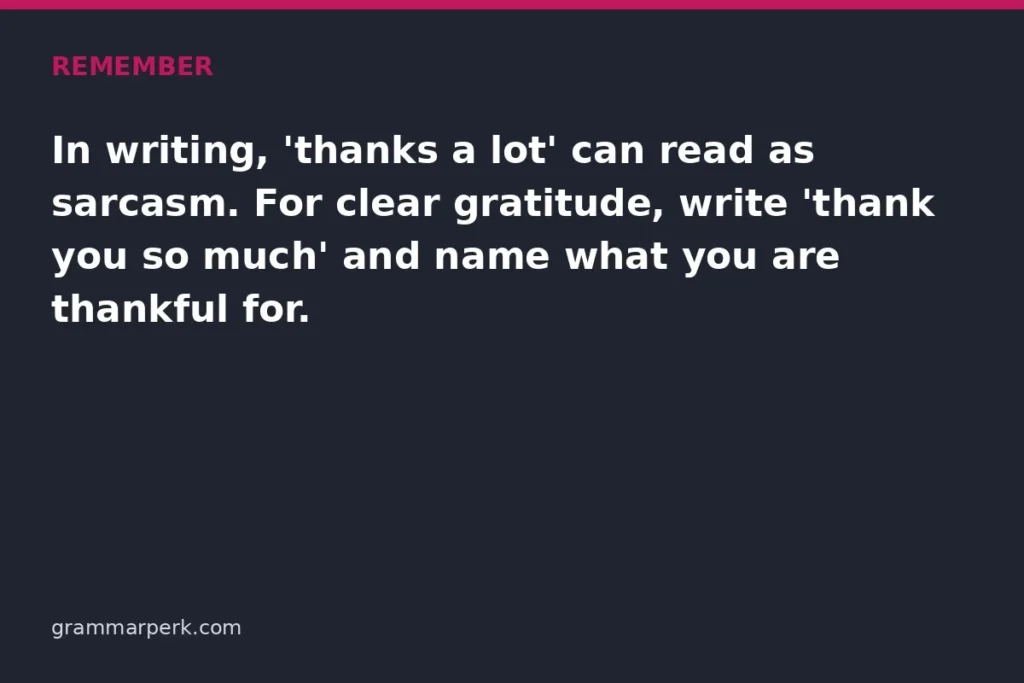
Writing removes all of those signals. In a text message, chat, or email, the reader must guess your tone — and may guess wrong. A bare “Thanks a lot.” with a full stop can look cold or even complaining. Small additions change the picture a lot:
- “Thanks a lot!” — the exclamation mark adds warmth and energy.
- “Thanks a lot for the quick reply!” — adding the reason makes sincerity clear.
- “Thanks a lot 🙏” — in casual chats, an emoji can soften the tone (never in formal emails).
- “Thanks a lot.” — the plain version, and the one most often read as sarcastic in writing.
Simple rule: the less your reader can hear you, the more specific your thanks should be.
Using “Thanks a Lot” in Different Settings
With Friends and Family
With people who know you well, “thanks a lot” is almost always safe: they know your voice, they can see your face, and they share your humour. Even the sarcastic version is fine as a clear joke — “Thanks a lot for eating my chips” with a grin is teasing, not anger.
At Work and in Professional Emails
At work, choose safety over style. Written messages to your manager, clients, or people you do not know well should use tone-proof phrases: “Thank you very much,” “Thank you for your assistance,” or “I appreciate your help.” Save “thanks a lot” for spoken thanks to colleagues you know — and add a clear reason: “Thanks a lot for covering my shift on Friday.”
With Strangers and Customer Service
To strangers, “thanks a lot” said warmly is perfectly polite — to the driver who waits, or the person who holds the door. But be careful in complaint situations: if a company has made a mistake and you write “Thanks a lot” in your complaint email, it will almost certainly be read as sarcasm.
When “Thanks a Lot” Gets Misunderstood — and How to Fix It
Misunderstandings usually happen in short written messages, stressful moments, and complaint situations, where the reader already expects negativity. If your “thanks a lot” lands badly, repair it quickly:
- Clarify at once: “I mean that sincerely — you really helped me today.”
- Add the missing detail: say exactly what the person did for you.
- Apologise lightly if needed: “Sorry, that came out flat — thank you, truly.”
A few extra sincere words fix almost every case.
Better Alternatives to “Thanks a Lot”
When you want gratitude with zero risk of misunderstanding, reach for one of these.
Formal and Professional Alternatives
- Thank you very much — the safest all-purpose polite thanks.
- Thank you so much for your assistance — warm and professional together.
- I appreciate your help / your time / your support — thoughtful and specific.
- Many thanks — a neat, polite email closer.
Casual and Friendly Alternatives
- Thanks so much — warm, simple, and almost never sarcastic.
- Thanks a bunch — playful and friendly, best with people you know.
- Appreciate it! — short and natural in everyday speech.
- You’re a lifesaver — perfect when someone rescued you from a problem.
Warm and Creative Alternatives
- I can’t thank you enough — for help that feels too big for words.
- Thanks a million — enthusiastic and cheerful.
- I’m really grateful — sincere in speech and writing alike.
Why Tone Changes Everything
Listeners judge emotion before logic. When words and tone disagree, the brain believes the tone. Expectations matter too: people who expect a complaint hear even neutral words negatively. That is why gratitude works best as a small package — the phrase, the reason, and a warm delivery together.
How “Thanks a Lot” Sounds Around the World
Cultures read gratitude differently. In some places, people take words at face value and rarely use ironic thanks, so “thanks a lot” is heard literally and kindly. In other places — much of the UK, the US, and Australia, for example — ironic humour is everyday conversation, so listeners check the tone first. For learners, the safe strategy everywhere is the same: add a reason (“Thanks a lot for the ride”) and keep your voice warm. Specific thanks translates across every culture.
Common Mistakes to Avoid
- Saying it right after bad news or a mistake: in that position, it almost always sounds sarcastic, whatever you intend.
- Using it alone in formal emails: a bare “Thanks a lot” to a manager or client is a tone gamble — write “Thank you very much” instead.
- Saying it flatly when you mean it kindly: a tired, flat delivery can turn sincere thanks into apparent sarcasm.
Tips for Saying Thank You Naturally
- Name the help: “Thanks a lot for the notes” beats “thanks a lot” alone, every time.
- Match the phrase to the setting: casual with friends, tone-safe and specific at work.
- Let your voice smile: a rising, warm tone is the sincerity signal listeners listen for.
- When in doubt, upgrade: “thank you so much” and “I really appreciate it” are almost impossible to misunderstand.
- Reply gracefully: when someone thanks you, “You’re welcome,” “Anytime,” and “Happy to help” all work well.
Quick Self-Check Quiz
Choose the best option for each situation.
- You are emailing your manager after she approved your leave. Best choice? (a) Thanks a lot. (b) Thank you very much for approving my leave.
- Your friend carried your heavy bags upstairs. Best choice? (a) Thanks a lot — you’re a lifesaver! (b) Thanks a LOT. (said flatly)
- A delivery arrives late and damaged. You write to the company: “Thanks a lot.” How will it be read? (a) Sincere (b) Sarcastic
- Which written version sounds warmest? (a) Thanks a lot. (b) Thanks a lot for your quick help!
- Which phrase is safest in both speech and writing? (a) Thank you so much (b) Thanks a lot
Answers: 1. (b) — formal writing deserves a tone-proof, specific phrase 2. (a) — real help plus warm words and detail = clearly sincere 3. (b) — after a problem, it reads as sarcasm 4. (b) — the reason and the exclamation mark add warmth 5. (a) — “thank you so much” is rarely misunderstood
Frequently Asked Questions
Is “thanks a lot” rude or sarcastic?
It can be either — tone and context decide. Said warmly after real help, it is friendly and sincere. Said flatly, or after something went wrong, it sounds sarcastic and annoyed.
Is “thanks a lot” grammatically correct?
Yes. “Thanks a lot” is a correct, natural fixed phrase in English (“a lot” = a great amount). It is informal, though, so in very formal writing prefer “thank you very much” or “I am very grateful.”
How can I make “thanks a lot” sound genuine?
Use a warm, rising voice and — most importantly — add what you are thankful for: “Thanks a lot for staying late; I really appreciate it.” Specific details are the strongest sincerity signal.
What should I say instead of “thanks a lot” in business emails?
Choose tone-proof phrases: “Thank you very much,” “Thank you so much for your assistance,” “I appreciate your help,” or “Many thanks.” Written words carry no voice, so never make an email depend on tone.
Is “thanks so much” better than “thanks a lot”?
Usually, yes. “Thanks so much” sounds warm and is rarely used sarcastically, so it is safer in writing and with people you do not know well. “Thanks a lot” simply asks more of your tone.
How do I reply when someone says “thanks a lot” to me?
Standard replies are “You’re welcome,” “No problem,” “Anytime,” “My pleasure,” and “Happy to help.” If the person was being sarcastic, a calm “I’m sorry about that — let me fix it” is the most graceful answer.
Final Conclusion
So, should you say “thanks a lot”? Yes — when someone has truly helped you and your voice is warm, it is a natural, friendly, polite phrase. Its one weakness: in writing, in formal settings, and after things go wrong, the same words can sound like a complaint. When the situation is delicate, switch to a tone-proof alternative like “thank you so much” or “I really appreciate it,” and always add the reason for your thanks. Gratitude that names the help is gratitude nobody can misunderstand.
Choosing words that say exactly what you mean is the heart of good English — practise with our guides to quaff or coif and neither vs either.