Setup vs Set Up: What’s the Difference?
Setup vs set up confuses almost every learner — and plenty of native speakers too. The difference is simple once you see it: “set up” (two words) is a verb, an action: “Please set up the chairs.” “Setup” (one word) is a noun or adjective, a thing or a description: “The setup looks great.” One creates something; the other names the result.
In this guide, you will learn the meaning of each form, the quick “do it or see it” test, plenty of examples, the hyphen question, common mistakes, and easy tricks to remember — plus why English has both forms in the first place. Whichever order you typed — set up vs setup, setup or set up — the setup vs set up meaning and the setup vs set up grammar rule are the same, and they are explained below.
The Short Answer
- Set up (two words) = an action. Use it when someone prepares, arranges, organises, or installs something: “I will set up the meeting.”
- Setup (one word) = a thing or description. Use it for the arrangement or system that results, or before a noun: “My desk setup is ready.” / “Follow the setup guide.”
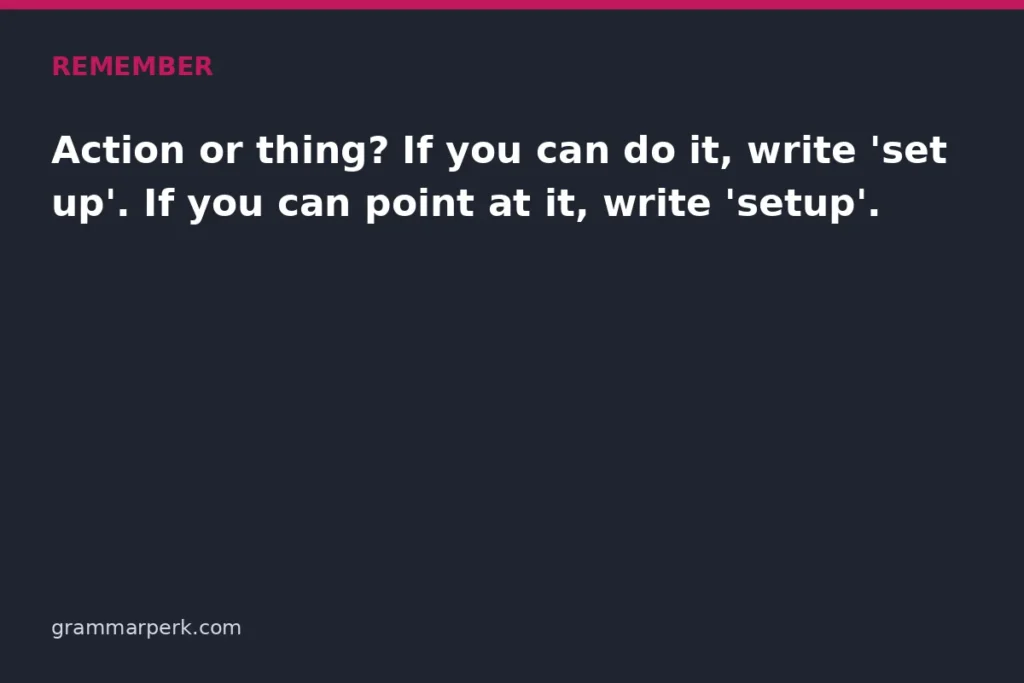
The quick test: Can you do it? Then it is “set up.” Can you see it or describe it? Then it is “setup.”
What Does “Set Up” Mean? (The Verb)
Set up is a phrasal verb meaning to prepare, arrange, organise, install, or create something so that it is ready to use. It always shows an action, and it is usually followed by the thing being prepared:
- “She set up the new computer in an hour.”
- “Can you set up a call for tomorrow?”
- “They are setting up the stage for the concert.”
Common Uses of “Set Up”
- Meetings and events: set up a meeting, set up an interview, set up the room.
- Technology: set up a phone, set up an account, set up Wi-Fi, set up a printer.
- Business and plans: set up a company, set up a system, set up a payment plan.
- Home life: set up a tent, set up the table, set up a study corner.
Synonyms for “Set Up”
Arrange, organise, prepare, install, create, establish. This gives you a second test: if you can replace the words with “arrange” and the sentence still works, you need the verb “set up”: “I will arrange the meeting” ✔.
Good News: The Past Tense Does Not Change
The verb “set” is irregular in a friendly way — its past form is also set. So yesterday you can say “We set up the office in the morning” (never “setted up”). And because “set up” is a separable phrasal verb, a pronoun goes in the middle: “Your account is ready — just set it up” (not “set up it”).
Examples of “Set Up” in Sentences
- Please set up your profile before the course starts.
- He set up his new laptop in twenty minutes.
- We need to set up chairs for fifty guests.
- The teacher set up a fun experiment for the class.
- I will set up the video call at nine.
- They set up a small bakery last year.
- Can you help me set up the tent?
- She is setting up her online shop this week.
What Does “Setup” Mean? (The Noun)
Setup is a noun: it names the way something is arranged, organised, or built — the result after the action of setting up is finished. The Cambridge Dictionary definition of setup describes it as the way in which things are organised or arranged. You can point at a setup, photograph it, like it, or improve it:
- “Your desk setup looks neat and calm.”
- “The office setup gives everyone more space.”
- “His gaming setup has two screens and a fast PC.”
Common Uses of “Setup”
- Work: office setup, work-from-home setup, meeting setup.
- Technology: computer setup, camera setup, home Wi-Fi setup.
- Creative spaces: studio setup, room setup, desk setup — choosing parts like a screen is easier once you know the difference between a screen, monitor, and display.
Synonyms for “Setup”
Arrangement, configuration, system, layout, organisation.
Two More Meanings of “Setup”
The noun “setup” has two extra, informal meanings worth knowing. It can mean a trap — a situation arranged to make someone look guilty: “He says the whole thing was a setup.” And in stories and films it means the opening situation that prepares the plot: “The setup of the film is simple: two strangers share a train cabin.”
“Setup” as an Adjective
“Setup” can also work as an adjective when it stands before a noun and describes it:
- “Read the setup guide first.”
- “The setup process takes five minutes.”
- “Use the setup checklist to check every cable.”
Remember: as an adjective, “setup” never stands alone — another noun always follows it.
Examples of “Setup” in Sentences
- This setup works well for small rooms.
- I like your streaming setup.
- The setup of the new office took one weekend — but I set it up myself.
- Follow the steps in the setup wizard.
- Her camera setup is simple but powerful.
- The meeting setup is ready; we can begin.
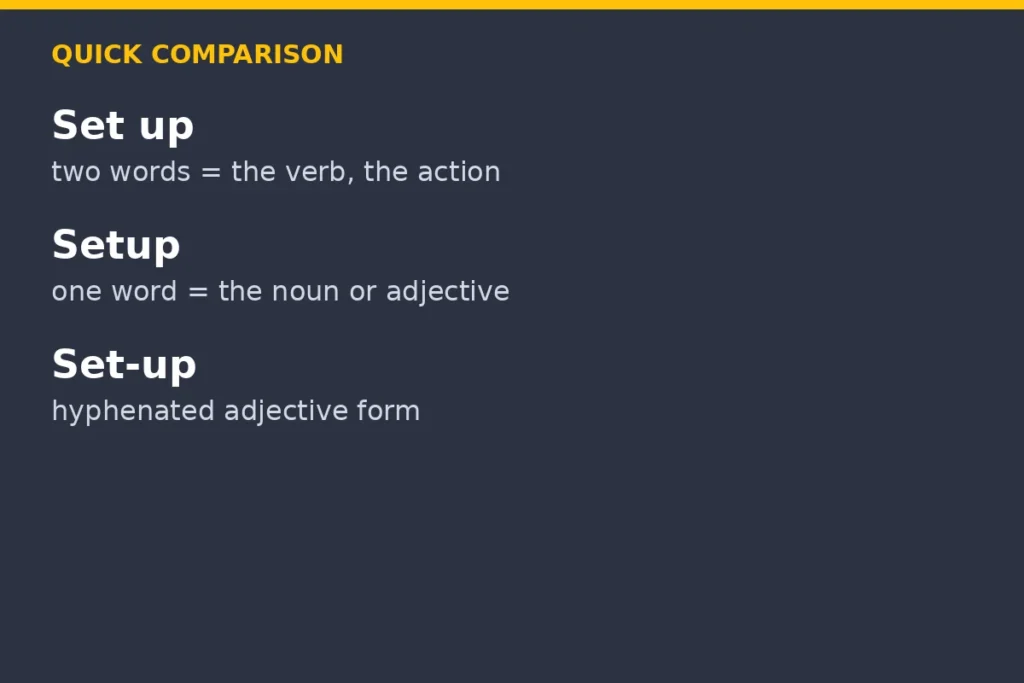
Quick Comparison: Setup vs Set Up
| Point | Set Up | Setup |
|---|---|---|
| Words | Two words | One word |
| Part of speech | Verb (action) | Noun or adjective (thing / description) |
| Meaning | To prepare, arrange, install | The arrangement or system that results |
| Quick test | Can you do it? Can you swap in “arrange”? | Can you see it? Can “the/a/this” stand before it? |
| Stress when speaking | set UP (stress on “up”) | SET-up (stress on “set”) |
| Example | Please set up the projector. | The projector setup is complete. |
Setup and Set Up in Different Contexts
Business Emails
Work writing mixes both forms constantly, so check each one: “I will set up the presentation at two. The meeting setup is already done.” One wrong form in a client email looks careless, even when the message is kind.
Technology and Instructions
Manuals use the adjective all the time — “setup instructions,” “setup file” — but the steps themselves use the verb: “To set up your router, plug it in first.”
Gaming, Desks, and Social Media
Online, “setup” is a star noun: people post photos of their “desk setup” or “gaming setup” and ask, “How did you set up that lighting?” The photo shows the setup; the caption explains how they set it up.
School and Exams
In exam answers, the verb should be two words: “The students set up the experiment carefully.” Writing “The students setup the experiment” is one of the most common small errors teachers correct.
Why Does English Have Both Forms?
English loves turning verb phrases into nouns. Two-word actions slowly squeeze into one-word things: you log in (verb) with your login (noun); you back up (verb) your files into a backup (noun). “Set up” → “setup” followed exactly the same path. First people performed the action for years; then they needed a name for the result, so the action word itself became the name.
How to Pronounce Setup and Set Up
The two forms look alike, but your voice separates them by stress. The noun “setup” stresses the first part: SET-up. The verb phrase stresses the second word: set UP. Listen: “That’s a great SETup — who set it UP?” Practising this stress pattern also helps you hear which form a speaker means, even before you see the words written.
Why People Confuse Setup and Set Up
They sound almost identical, and in fast writing the brain often chooses the form it has seen most recently. Social media makes it worse: “desk setup” appears in thousands of photos, so the one-word noun sticks in the mind and escapes into verb sentences: “I need to setup my desk.” Add the fact that spellcheckers accept both spellings — both are real words — and the mistake passes quietly. Word-form pairs like this appear everywhere in English; our guide to smoothe vs smooth shows another pair where one small letter changes the grammar job.
Common Mistakes to Avoid
- Using “setup” as a verb: ✗ “I will setup the meeting.” → ✔ “I will set up the meeting.”
- Using “set up” as a noun: ✗ “Please set up is complete.” → ✔ “The setup is complete.”
- Wrong past tense: ✗ “Yesterday we setted up the room.” → ✔ “Yesterday we set up the room.” (“Set” does not change.)
- Pronoun in the wrong place: ✗ “Set up it now.” → ✔ “Set it up now.”
- Hyphenating everything: ✗ “a set-up guide” is old-fashioned. → ✔ Modern English prefers “a setup guide.”
- Mixing both forms in one sentence: ✗ “Setup the setup quickly.” → ✔ “Set up the setup quickly.”
Tricks to Remember
- The do/see test. If you can do it, write “set up.” If you can see it, write “setup.”
- The “arrange” swap. Replace the words with “arrange.” If the sentence still works, it is the verb: “set up.”
- The article test. Nouns can follow “the, a, my, this”: “the setup,” “my setup” ✔. Verbs never can: “the set up” ✗.
- Look at what comes after. A thing being prepared (an object) means a verb is at work: “set up + the chairs.” Another noun right after means the adjective: “setup + guide.”
- Read it aloud with stress. SET-up (thing) vs set UP (action). If you stress “up,” use two words.
- Remember the order of life. First you set up (action), then you admire the setup (thing). The action always comes first.
Self-Check Quiz
- Please ______ (setup / set up) the projector before class.
- Her desk ______ (setup / set up) includes two monitors.
- We ______ (setup / set up) the shop last spring.
- Open the ______ (setup / set up) file to begin installation.
- The ______ (setup / set up) is finished, so just ______ (setup / set it up) and press start.
- Is this sentence correct? “I setup my account yesterday.”
Answers: 1. set up (an action) 2. setup (a thing — her desk arrangement) 3. set up (an action; note the past tense stays “set up”) 4. setup (an adjective before the noun “file”) 5. setup; set it up (noun first, then the verb with the pronoun in the middle) 6. No — “setup” cannot be a verb. Correct: “I set up my account yesterday.”
Frequently Asked Questions
What is the main difference between “setup” and “set up”?
“Set up” (two words) is a verb — the action of preparing or arranging something. “Setup” (one word) is a noun or adjective — the arrangement that results, or a description before a noun. Action: “set up.” Thing: “setup.”
Can “setup” ever be used as a verb?
No. In standard English “setup” is never a verb. Sentences like “I setup my computer” are always errors. Write “I set up my computer” — two words — whenever someone performs the action.
Do you “set up” or “setup” a meeting?
You always set up a meeting, because arranging it is an action. Afterwards, you can talk about the meeting setup — the room, the chairs, and the screen — because that is a thing.
Is “set up” ever hyphenated as “set-up”?
Rarely, and it looks dated today. Older writing sometimes used “set-up” before nouns, but modern English strongly prefers the one-word adjective “setup”: “a setup guide,” “the setup process.”
Do American and British English use “setup” and “set up” differently?
No. Both varieties follow exactly the same rule: “set up” for the action, “setup” for the thing or description. This is one spelling pair you never need to adjust when you cross the Atlantic.
How can I remember the difference easily?
Use the do/see test. Ask: “Can I do it, or can I see it?” Doing means the two-word verb “set up”; seeing means the one-word noun “setup.” Remember the order of events: first you set it up, then you enjoy the setup.
Final Conclusion
Setup vs set up is a spelling question with a grammar answer: actions take two words, things take one. You set up the room, then you admire the room setup. Apply the do/see test, listen for the stress (set UP vs SET-up), and remember that “set” keeps its form in the past — and this small pair will never trouble your writing again.