In the Street vs On the Street: What Is the Difference?
Should you say “in the street” or “on the street”? Good news first: very often, both sentences describe the same picture — someone is outside, on a road in a town or city. The difference is mainly a habit of the country. British English usually says “in the street” (“Children were playing in the street”), while American English usually says “on the street” (“Children were playing on the street”). Neither one is a mistake. This question is typed many ways — in street vs on street, or on the street vs in the street — and it is really about dialect and about where exactly a person or thing is; both points are explained below.
But the story does not end there. “In the street” can stress being in the road itself, among the cars. “On the street” carries famous idioms — a person with no home “lives on the streets,” and gossip is “the word on the street.” And a third word, at, has its own job: “at the corner,” “at the end of the street.” This guide explains the real rule, the British and American difference, street-name addresses, the idioms, clear examples, and common mistakes.
The Short Answer
- In the street — the usual British choice for a person or thing located in a street. It can also stress being in the road itself, where the cars drive: “Don’t play in the street!”
- On the street — the usual American choice for the same idea. It also appears in idioms about having no home or about public gossip.
- At the street — almost never correct on its own. Use at for a point: at the corner, at the end of the street, at the traffic lights.
What Does “In the Street” Mean?
In the street means located within the space of a street — out on the road area, between the buildings on either side. It is the normal, everyday choice in British English for people, cars, and things in a street. The Cambridge Dictionary entry for street shows British examples built with “in,” because British speakers picture the person inside the long open space of the street.
Common uses of “in the street”
- People located there: “A crowd gathered in the street.” “Two men were talking in the street outside my house.”
- Parked cars and objects: “You can’t park in this street.” “There was a broken bicycle lying in the street.”
- Safety warnings: “Don’t run into the street!” — here “in the street” clearly means in the road, where traffic moves. This warning is common in American English too.
- British addresses: British speakers say “in + street name”: “She lives in Baker Street.” “Our office is in the High Street.”
Picture it: imagine standing in the middle of a road, with the street all around you and cars passing — you are in the street. That picture of being inside the street’s space is why “in” feels right to British ears.
What Does “On the Street” Mean?
On the street means on the surface of the street, or simply out in its public space. It is the normal, everyday choice in American English for the same scenes where British speakers say “in the street” — American speakers picture the person standing on the ground surface of the road, the way you stand on a floor.
Common uses of “on the street”
- People located there: “Kids were playing on the street.” “There were not many people on the street at midnight.”
- Walking and activity: “Vendors sell fruit on the street every morning.” “Musicians perform on the street at weekends.”
- American addresses: American speakers say “on + street name”: “He lives on Fifth Avenue.” “The café is on Main Street.”
Picture it: imagine a photo taken from above — a person standing on the flat surface of the road. That surface picture is why “on” feels right to American ears.
“On the Street” in Idioms
Here is where “on” truly separates itself from “in”: a family of idioms that always use on, in every country. You cannot exchange these for “in the street.”
- On the street / on the streets = homeless, with no home: “After he lost his job, he ended up living on the streets.” “The charity helps people who sleep on the street.” Note that “on the streets” (plural) is the most common form for this meaning.
- The word on the street = what people are saying; gossip or rumour: “The word on the street is that the company will close in June.” News headlines love this phrase.
- The man on the street = the ordinary, average person: “What does the man on the street think about the new tax?”
- Take to the streets = go out in public to protest: “Thousands took to the streets after the decision.” (The whole phrase is fixed.)
“In the street” has almost no idioms of its own; it stays literal. When the meaning is figurative — homelessness, gossip, ordinary people — English reaches for “on the street(s)” every time.
What About “At the Street”?
Learners often ask about a third option: at. On its own, “at the street” is almost never correct — ✗ “Meet me at the street.” But “at” is the right word for a point connected with a street:
- At the corner: “I’ll wait for you at the corner of the street.”
- At the end of the street: “Turn left at the end of the street.”
- At the traffic lights / at the crossing: “We stopped at the traffic lights.”
- At + house number + street: “Sherlock Holmes lived at 221B Baker Street.” When an exact address number is given, both British and American English use “at”: “She works at 350 Fifth Avenue.”
Think of it this way: in and on describe being in the street area; at points to one exact spot.
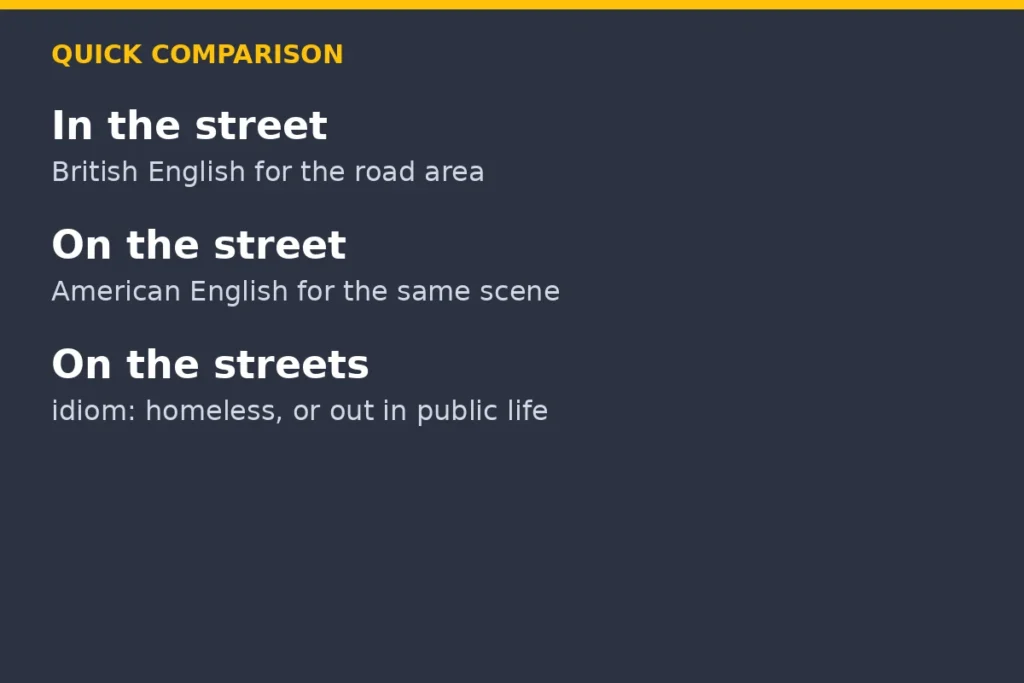
Quick Comparison: In the Street vs On the Street
| Point | In the Street | On the Street |
|---|---|---|
| Main use | Located within the street’s space | Located on the street’s surface / in public |
| Favoured in | British English | American English |
| Street addresses | “in Baker Street” (BrE) | “on Fifth Avenue” (AmE) |
| Special stress | In the road itself, among traffic: “Don’t play in the street!” | Out in public, generally |
| Idioms | Almost none — stays literal | On the streets (homeless); word on the street; man on the street |
| Example | Children were playing in the street. (BrE) | Children were playing on the street. (AmE) |
Examples of “In the Street” in Sentences
- Children were playing in the street outside our house. (British style)
- A crowd stood in the street, watching the parade.
- Don’t play in the street — the cars come fast on this road!
- There was a piano in the middle of the street after the flood.
- She lives in a quiet street near the station. (BrE address style)
- Cars were parked in the street all the way to the corner.
Examples of “On the Street” in Sentences
- Kids were riding their bikes on the street. (American style)
- Vendors sell hot food on the street every evening.
- I met an old school friend on the street yesterday.
- He lives on Maple Street, two doors from the bakery. (AmE address style)
- Sadly, some families are forced to sleep on the streets. (idiom: homeless)
- The word on the street is that a new supermarket is coming to our town. (idiom: gossip)
In the Street and On the Street in Different Contexts
Giving your address
Here the regional rule matters most. British: “I live in Church Street.” American: “I live on Church Street.” Add a house number and both switch to “at”: “I live at 14 Church Street.”
Safety and warnings
Warnings about traffic use in the street in both countries, because the danger zone is the road itself: “Look both ways before you step into the street.” “Never play in the street!” A parent in Texas and a parent in London shout the same sentence here.
News headlines and reports
News writing uses both, plus the idioms. British report: “Hundreds gathered in the street after the match.” American report: “Protesters on the street demanded change.” And everywhere: “The word on the street is…” for rumours, and “people sleeping on the streets” for homelessness.
Describing a scene
For everyday scenes — people walking, shops, parked cars, neighbours chatting — simply follow your variety of English. British “People were chatting in the street” and American “on the street” are both correct; consistency inside one text matters more than the choice.
Which verbs go with each?
Verbs of position inside the road area — stand, sit, lie, gather, play — happily take “in the street” (especially in BrE), while verbs of movement along the surface — walk, stroll — happily take “on the street” (especially in AmE). But this is a tendency, not a law: the regional habit is stronger than the verb. British speakers also say “walking in the street,” and Americans park cars “on the street.”
Why People Confuse “In the Street” and “On the Street”
Why is this pair so tricky? First, both can be correct for the same scene, so there is no single answer to memorise — the choice depends on region and idiom. Second, many languages use only one word for both ideas, so learners must build a distinction their first language does not make. Third, the idioms hide inside the same words: a learner hears “living on the streets” and wonders if “in” would work there too — it would not. Small words carrying regional habits and idioms at once are a classic English trap, much like choosing between two similar forms in pairs such as neither vs either.
Common Mistakes to Avoid
- Saying “at the street”: ✗ “Meet me at the street at six.” → ✔ “Meet me at the corner of the street at six,” or “Meet me on the street at six.” “At” needs a point, not the whole street.
- Using “in” in the homeless idiom: ✗ “He lost his home and now lives in the streets.” → ✔ “He now lives on the streets.” The idiom is fixed with “on.”
- Mixing address systems in one sentence: ✗ “She lives in Fifth Avenue at New York.” → ✔ “She lives on Fifth Avenue in New York.” (American street → on; city → in.) British version: “She lives in Baker Street, in London.”
- Believing one form is simply wrong: ✗ “British people say ‘in the street’, so ‘on the street’ is incorrect.” → ✔ Both are correct; they belong to different varieties of English.
- Forgetting “at” with exact addresses: ✗ “The museum is in 220 Main Street.” → ✔ “The museum is at 220 Main Street.” A house number takes “at” in both British and American English.
Tricks to Remember
- Follow your flag: learning British English? Default to in the street and “in + street name.” Learning American English? Default to on the street and “on + street name.”
- IN = in the road: for danger in the roadway, everyone says in: “Don’t play in the street!” Picture the child surrounded by the road.
- ON = idioms: homelessness, gossip, and the average person all live on the street(s): on the streets, word on the street, man on the street.
- AT = a point on the map: corner, end, traffic lights, house number — if you can point to one spot, use at.
Self-Check Quiz
- (British English) “The children are playing ______ the street.” — in or on?
- (American English) “She lives ______ Main Street.” — in or on?
- “After losing his job, he was living ______ the streets.” — in or on?
- “I’ll meet you ______ the end of the street.” — at, in, or on?
- “The famous detective lived ______ 221B Baker Street.” — at, in, or on?
Answers: 1. In (the British habit for location in a street). 2. On (the American habit for street addresses). 3. On (the homeless idiom is fixed: “on the streets”). 4. At (the end of the street is a point). 5. At (an exact house number takes “at” in both varieties).
Frequently Asked Questions
What does “in the street” mean?
It means located within the space of a street — out on the road area between the buildings. It is the usual British English choice: “Children were playing in the street.” It can also stress being in the road itself, among traffic: “Don’t play in the street!”
What does “on the street” mean?
It means on the surface of the street, or out in its public space — the usual American English choice for the same scenes: “Kids were playing on the street.” It is also the form used in idioms about homelessness and gossip.
Can “in the street” and “on the street” be used interchangeably?
For simple location, mostly yes — listeners in both countries understand both, and they describe the same picture. But not in idioms (“on the streets” = homeless) or street-name addresses, where each variety keeps its own habit.
Which one is correct for addresses — “in Baker Street” or “on Baker Street”?
Both, by region: British English says “in Baker Street,” American English says “on Baker Street.” If you add the house number, both use “at”: “at 221B Baker Street.”
Is “at the street” ever correct?
Almost never by itself. “At” is used for a point connected with a street: at the corner, at the end of the street, at the traffic lights, or at an exact address with a number. Say “Meet me at the corner,” not “at the street.”
What does “on the streets” mean?
It is an idiom meaning homeless — having no home and living outdoors: “The charity feeds people who live on the streets.” A related phrase, “the word on the street,” means what people are saying — gossip or rumour.
Final Conclusion
In the street vs on the street is not a battle with one winner — it is a regional habit with a few fixed rules on top. Use in the street like a British speaker (and for anyone standing in the road itself), use on the street like an American speaker, and never swap the idioms: homeless people live on the streets, and gossip is the word on the street. Keep at for points — the corner, the end of the street, numbered addresses. Follow your variety of English consistently, and this pair will never confuse you again. For more small-word choices explained the same simple way, see our guide to assume vs presume vs infer.