No Difference vs No Different: Which One Is Correct?
“There is no difference” or “it is no different”? Learners ask it both ways — is it no different, or is it no difference? The two phrases mean almost the same thing, but they are not interchangeable. One is built around a noun and the other around an adjective, and choosing the wrong one produces sentences like “It makes no different” — a mistake learners make every day.
In this guide, you will learn the simple noun-versus-adjective rule behind no difference vs no different, the sentence patterns each phrase needs, the from / than / to question, lots of examples, and easy memory tricks.
Quick Answer: One Is a Noun, One Is an Adjective
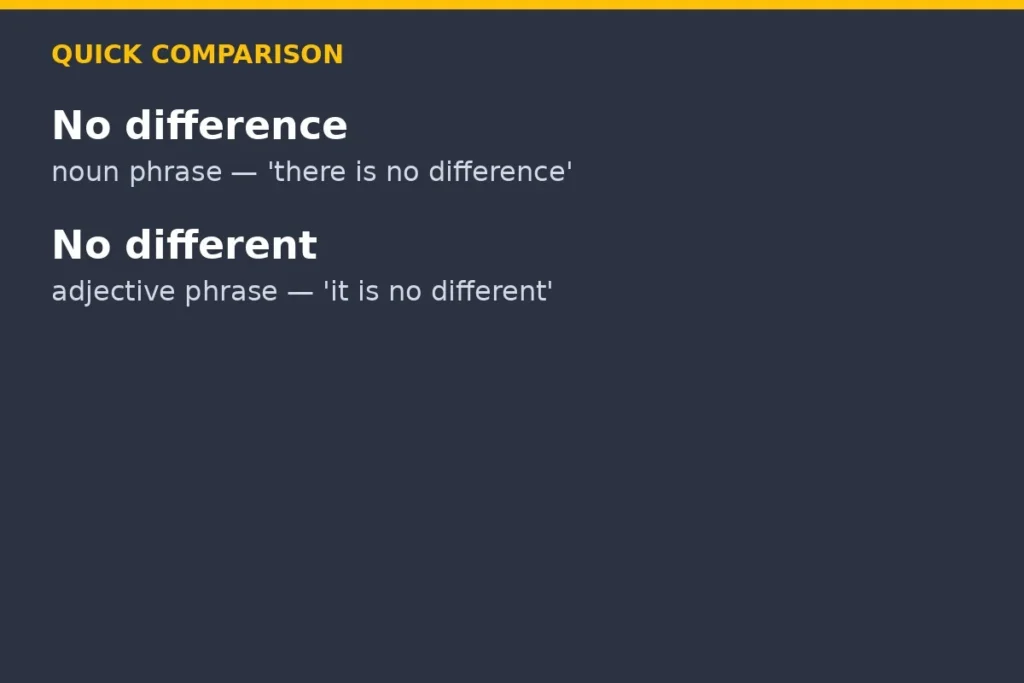
- Difference is a noun — a thing. So “no difference” is a noun phrase: “There is no difference between the two phones.”
- Different is an adjective — a describing word. So “no different” describes something: “This phone is no different from the old one.”
That is the whole secret. If your sentence needs a noun — something that can be seen, made, or counted — use “no difference.” If your sentence describes a person or thing as being the same as something else, use “no different.” Everything below is just this rule in action.
Nouns, Adjectives, and Adverbs: The 10-Second Basics
The words difference and different come from the same family, and each member has a different job:
- Difference (noun) — names the gap between two things: “Can you see the difference?”
- Different (adjective) — describes a noun as not the same: “We took a different road.”
- Differently (adverb) — describes how an action is done: “She sings differently now.”
A quick test for adjectives: they fit after the verb “be” and before a noun — “it is different,” “a different plan.” A noun can follow verbs like “make,” “see,” and “notice,” and can be the subject of a sentence — “The difference is clear.” The Cambridge Dictionary entry for different labels the word as an adjective, which is exactly why “no different” can only describe something, never name a thing. Keep the three family members separate and most mistakes disappear.
“No Difference”: The Noun Phrase
Use “no difference” when you are talking about the absence of a gap between two things as an idea or a result. It appears in a few very common patterns:
Pattern 1: There is / are no difference between A and B
- There is no difference between the two options.
- There is no difference in price between the red car and the blue one.
- There are no differences between the two reports. (Plural “differences” is also fine when there could be several.)
Pattern 2: Make no difference (to someone)
- It makes no difference to me — choose whichever you like.
- Morning or evening makes no difference; I am free all day.
- Your opinion makes no difference here; the rule is fixed.
- One apology makes no difference now — the damage is done.
“Make no difference” is a fixed expression meaning “does not change the result or outcome.” You can also ask, “What difference does it make?” — meaning “why does it matter?”
Pattern 3: See / notice / find no difference
- I can see no difference between these two pictures.
- The judges noticed no difference in the results.
- Online exams show no difference in scores.
In every pattern, “difference” is doing noun work: it can be a subject (“No difference was found”), an object (“It makes no difference”), or follow “there is.”
“No Different”: The Adjective Phrase
Use “no different” when you describe one thing as being the same as another. It almost always follows a verb like be, look, feel, or seem, and it needs a comparison — usually introduced by “from.”
- His answer is no different from mine.
- This phone is no different from the old one.
- Online classes are no different from in-person ones.
- The sequel feels no different from the original film.
- Your reaction is no different from before.
- This strategy is no different from the last one we tried.
Notice the shape: something + be/feel/look + no different + from + something else. If there is no comparison — nothing for the thing to be “the same as” — “no different” usually does not fit, and “no difference” is probably the phrase you need.
Quick Comparison: No Difference vs No Different
| Point | No Difference | No Different |
|---|---|---|
| Part of speech | Noun phrase (difference = noun) | Adjective phrase (different = adjective) |
| Job in the sentence | Names the absence of a gap | Describes something as the same as another thing |
| Common patterns | There is no difference between…; It makes no difference | It is no different from… |
| Needs a comparison word? | Often “between” | Usually “from” (sometimes “than” or “to”) |
| Example | There is no difference in taste. | It tastes no different from the original. |
Correct and Incorrect Examples
- ✔ It makes no difference to me. / ✗ It makes no different to me. (“Make” needs a noun after it.)
- ✔ There is no difference between them. / ✗ There is no different between them.
- ✔ She is no different from her sister. / ✗ She is no difference from her sister.
- ✔ This model is no different from the last. / ✗ This model is no different the last. (The preposition is missing.)
- ✔ I see no difference in quality. / ✗ I see no different in quality.
- ✔ The plan looks no different today. / ✗ The plan looks no difference today. (“Look” here needs an adjective.)
Small word-form choices like this are everywhere in English — our guide to smoothe vs smooth shows another pair where the wrong form sneaks into writing.
“No Different From”, “No Different Than”, or “Different To”?
The adjective “different” needs a preposition to connect it to the thing it is compared with, and English offers three:
- Different from — the safest and most standard choice everywhere, and the one teachers and editors prefer: “This is no different from that.”
- Different than — very common in American English, especially in speech and before a clause: “The result was no different than we expected.” Many style guides accept it, but “from” is safer in formal writing.
- Different to — common in British English speech: “It is no different to yesterday.” It sounds normal in the UK but unusual in the US.
Simple advice: write “no different from” in anything formal. In casual American conversation, “no different than” will sound completely natural, and nobody will correct you.
No Difference vs No Different in Real Life
At work and with money
- The price rise makes no difference to our budget.
- This supplier is no different from the previous one — same quality, same price.
At school
- The study found no difference between the two teaching methods.
- Learning online is no different from learning in a classroom if you practise daily.
At home and in daily life
- Hot or cold, it makes no difference — I drink tea all year.
- The new haircut looks no different from the old one.
- Making the right choice between two similar-looking forms is a daily English problem — our neither vs either guide solves another one the same way.
Common Mistakes to Avoid
- “It makes no different.” The biggest mistake of all. “Make” must be followed by a noun, so only “It makes no difference” is correct.
- “There is no different.” After “there is,” you need a noun phrase: “There is no difference.”
- Forgetting the preposition. “It is no different my plan” is incomplete. An adjective comparison needs “from”: “It is no different from my plan.”
- Using “no difference” as a description. “The two soups are no difference” is wrong — after “be,” a description (adjective) is needed: “The two soups are no different.”
- Mixing “differently” into the pair. “Differently” is an adverb and only describes actions: “He behaves differently now.” It can never replace difference or different in these phrases.
Tips to Remember
- Ask: am I naming or describing? Naming an idea or result → “no difference.” Describing a thing → “no different.”
- The “make” test. After make, see, notice, or find, you need the noun: “makes no difference.”
- The “be” test. After is, are, looks, feels, or seems, and before “from,” you need the adjective: “is no different from.”
- Difference ends in -ence — think “thing.” Nouns name things; the word with the “thing-like” ending is your noun. Different ends in -ent, like other adjectives: absent, present, excellent.
- When in doubt, rebuild the sentence. “There is no difference between X and Y” and “X is no different from Y” say the same thing — pick the shape you are sure about.
Self-Check Quiz
Fill each gap with difference or different, then check the answers.
- It makes no ___ to me which day we meet.
- This version is no ___ from the old one.
- There is no ___ between the two prices.
- The twins look no ___ from each other in photos.
- Can you see any ___ in the design? I can see no ___ at all.
Answers: 1. difference (after “makes” — noun) 2. different (adjective, with “from”) 3. difference (after “there is” — noun) 4. different (describes the twins) 5. difference; difference (after “see” — noun)
Frequently Asked Questions
Can I say “it makes no different”?
No, that is incorrect. The verb “make” needs a noun after it, and “different” is an adjective. The correct sentence is “It makes no difference.” This is the most common error with this pair, so if you remember only one rule, remember this one.
Is “no different than” correct?
It is widely used in American English, especially in speech, and most listeners accept it. However, “no different from” is the traditional and safest form, and it is the one to choose in formal writing, exams, and professional documents.
What is the difference between “no difference” and “not different”?
“No difference” is a noun phrase naming the absence of a gap: “There is no difference.” “Not different” simply negates the adjective: “The two are not different.” They point to the same idea, but they fit different sentence shapes — “not different” works after “be,” while “no difference” works as a subject or object.
Which is more common in spoken English?
Both are very common. “No different” feels slightly more conversational because it describes things directly, while “no difference” appears often in neutral and formal statements like “It makes no difference.” In everyday speech you will hear the two many times a day.
Can “no difference” and “no different” be used interchangeably?
No. They have similar meanings but different grammar. Swapping them breaks the sentence: “It makes no different” and “She is no difference from me” are both wrong. Let the sentence structure — noun slot or adjective slot — choose the phrase for you.
Is it “different from”, “different than”, or “different to”?
“Different from” is correct everywhere and always safe. “Different than” is common in American English, especially before clauses. “Different to” is common in British speech. For formal writing in any country, “different from” is the best choice.
Final Conclusion
No difference vs no different comes down to one question: does your sentence need a noun or an adjective? “Difference” is a noun, so it names the missing gap — “there is no difference,” “it makes no difference.” “Different” is an adjective, so it describes — “it is no different from before.” Watch the verb in front of the phrase, add “from” after “different,” and the right choice becomes automatic.