Has Run vs Has Ran: Which One Is Correct?
“Has run” or “has ran” — which one is correct? The answer never changes: “has run” is correct, and “has ran” is always wrong. The reason is one simple rule: after has or have, English always uses the past participle of the verb. For “run,” the past participle is “run” — not “ran.” “Ran” is only the simple past, and it must stand alone, without “has.”
In this guide, you will learn the three forms of “run,” why “has run” is correct, why “has ran” is wrong, how “has run” and “ran” differ, other verbs with the same pattern, common mistakes, memory tricks, and a short quiz. At heart this is a ran vs run problem — it starts with the past tense of run — and one small table settles it for good.
The Short Answer: Always “Has Run”
- ✔ “She has run three miles today.”
- ✗ “She has ran three miles today.”
- ✔ “She ran three miles yesterday.” (“ran” alone, for a finished past time)
Think of it as a lock and key: has/have only opens with a past participle. Whenever you see “has,” “have,” or “had,” check the verb that follows it — it must be the participle form.
The Verb “Run”: Its Three Forms
“Run” is an irregular verb: its forms do not follow the normal “-ed” rule. It belongs to a small family of verbs whose past participle goes back to the base form:
| Form | Word | Example |
|---|---|---|
| Base form (present) | run | I run every morning. |
| Simple past | ran | I ran five kilometres yesterday. |
| Past participle | run | I have run five kilometres before. |
The pattern is run – ran – run. The simple past and the participle are different words, and that single difference is the whole problem. Similar verbs exist in English — the Cambridge Dictionary entry for “run” lists its forms as run, ran, run, exactly as shown here.
“Has Run”: The Correct Form (Present Perfect)
“Has run” is the present perfect tense. It is built like this:
has/have + past participle → has + run
The present perfect connects a past action with the present moment. It is used for:
- Experience: “She has run a marathon twice.” (at some time in her life up to now)
- Results that matter now: “He has run out of petrol, so the car won’t start.” (the result affects us now)
- Actions continuing until now: “He has run this shop for ten years.” (he still runs it)
- Recent actions: “The program has run successfully.” (just finished)
“Has Run” or “Have Run”?
Both are correct — the choice depends on the subject:
- has run — with he, she, it, or one person/thing: “She has run…”, “The machine has run…”
- have run — with I, you, we, they, or plurals: “I have run…”, “They have run…”
Questions and Negatives
- Question: “Has she run the race yet?” / “Have you run before?”
- Negative: “He hasn’t run since June.” / “We have not run the new system yet.”
Notice that in every shape — statement, question, negative — the verb after has/have stays “run.”
“Has Ran”: Why It Is Always Incorrect
“Has ran” mixes two different tenses in one phrase. “Has” belongs to the present perfect, which demands the past participle. “Ran” belongs to the simple past, which never uses a helper verb. The two halves do not fit together:
- ✗ “She has ran away.” → ✔ “She has run away.”
- ✗ “The system has ran overnight.” → ✔ “The system has run overnight.”
- ✗ “He has ran fast.” → ✔ “He has run fast.”
You may hear “has ran” in casual speech in some regions, but it is not standard English. In exams, job applications, emails, and all careful writing, it counts as a grammar error.
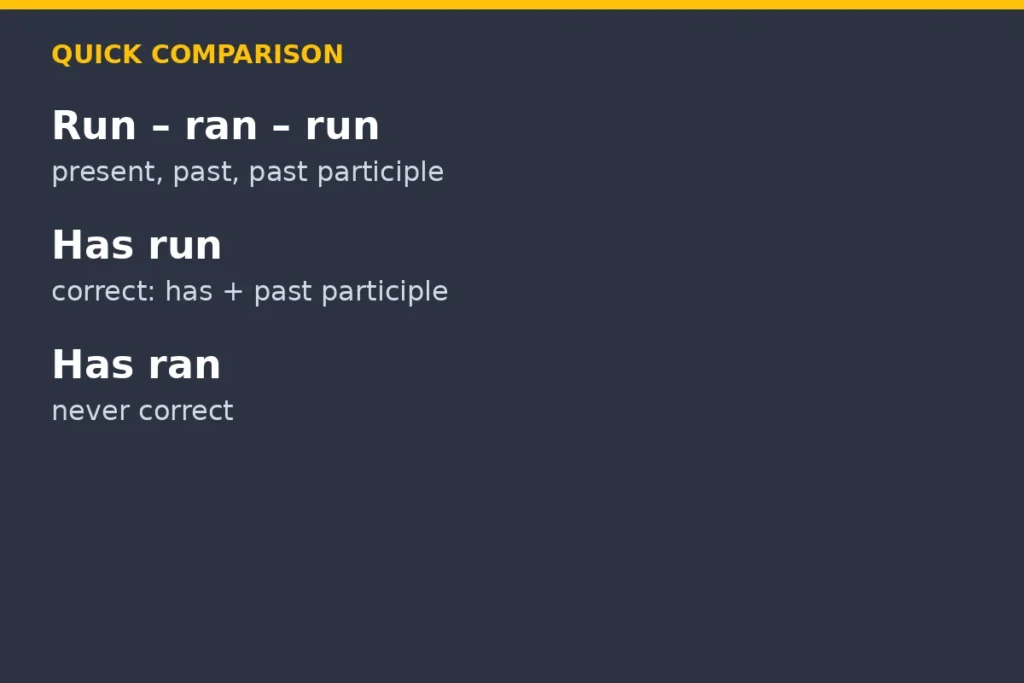
Quick Comparison: “Has Run” vs “Has Ran” vs “Ran”
| Form | Correct? | Tense / Job | Example |
|---|---|---|---|
| has run / have run | ✔ Yes | Present perfect — past action connected to now | She has run three miles today. |
| has ran | ✗ No | A mix of two tenses — never correct | — |
| ran (alone) | ✔ Yes | Simple past — finished action at a finished time | She ran three miles yesterday. |
Examples of “Has Run” in Sentences
- Sports: “She has run five kilometres today, and she is not finished yet.”
- Business: “He has run the family business since 2015.”
- Machines: “The washing machine has run twice this morning.”
- Technology: “The update has run without any errors.”
- Daily life: “My phone has run out of battery again.”
- Formal: “The project has run ahead of schedule.”
- Academic: “The study has run for six months and continues today.”
“Has Run” vs “Ran”: Choosing the Right Tense
Both forms are correct English — they simply answer different questions:
- Use ran (simple past) when the action is finished and the time is finished and named: “She ran yesterday.” “He ran the shop from 2010 to 2020.” (then stopped)
- Use has run (present perfect) when no finished time is given, or the action still connects to now: “She has run today.” “He has run the shop for years.” (he still does)
A useful signal: words like yesterday, last week, in 2019, two days ago need “ran.” Words like today, already, yet, since, for, ever, never usually need “has run.” Choosing between two forms is a familiar English task — our guide to neither vs either trains the same skill with another famous pair.
Other Verbs with the Same Pattern
“Run” is not alone. Many common irregular verbs change in the middle form and then change again for the participle. Learners often make the same mistake with them (“has began,” “has swam”):
| Base | Simple Past | Past Participle (after has/have) |
|---|---|---|
| run | ran | run — She has run. |
| begin | began | begun — The film has begun. |
| swim | swam | swum — He has swum in the sea. |
| sing | sang | sung — They have sung this song before. |
| drink | drank | drunk — She has drunk all the water. |
| ring | rang | rung — The bell has rung. |
| sink | sank | sunk — The boat has sunk. |
The rule is identical for all of them: after has/have, use the third column — never the second.
“Has Run” in Different Contexts
Sport and Exercise
“Has run” reports training and results that matter now: “Our captain has run more than anyone this season.”
Business and Work
“Run” also means manage: “She has run the department for five years.” In a workplace email, the wrong form hurts you — writing “The system has ran overnight” can make readers doubt both the message and the writer. “The system has run overnight” is clear and professional.
Machines and Technology
Engines, programs, and systems “run” too: “The engine has run smoothly all day.” “The test has run successfully.” Verb forms in technical English follow the same rules — our guide to headed vs heading covers another form pair that professionals mix up.
Everyday Phrases
“Run out of” means to have nothing left: “We have run out of milk.” “Time has run out.” These phrases always use “run” after has/have.
Why People Confuse “Has Run” and “Has Ran”
The confusion has three causes. First, sound: in fast speech, “ran” is the form learners hear most often in stories about the past, so it feels like “the past word” for every situation. Second, irregular forms: “run” does not follow the tidy “-ed” pattern of regular verbs, so learners must memorise three separate shapes — and the middle one, “ran,” is the most noticeable. Third, overcorrection in both directions: some learners, told that “ran” needs no helper, start dropping “has” where it belongs, or push “ran” after “has” because both words feel “past.” The cure is the one-rule check: see “has,” demand the participle.
Common Mistakes to Avoid
- Putting “ran” after “has”: ✗ “She has ran late.” → ✔ “She has run late.”
- Mixing tenses with a finished time: ✗ “She has run yesterday.” → ✔ “She ran yesterday.” (Finished time words need the simple past.)
- Forgetting the helper: ✗ “She run the race already.” → ✔ “She has run the race already.”
- Using “has” with the wrong subject: ✗ “They has run.” → ✔ “They have run.” (has = he/she/it only)
- Repeating the mistake with sister verbs: ✗ “The film has began.” → ✔ “The film has begun.”
Tricks to Remember
- “Has = helper, participle = partner.” The helper verb “has” always brings its partner, the past participle. For run, the partner is “run.”
- The timeline test: Can you point to a finished time (yesterday, last year)? Use “ran” alone. Is the action connected to now, or is no time given? Use “has run.”
- Run – ran – run, like a circle: The verb starts and ends with the same word (run … run), with “ran” in the middle only. “Has” always jumps to the end of the circle.
- The “has” alarm: Train your eye so that the word “has” rings a small alarm: participle next! If the next word is “ran,” “began,” or “swam,” fix it.
Self-Check Quiz
- Fill in the blank: “She has ___ three miles.” (run / ran)
- Fill in the blank: “He ___ to the station yesterday.” (has run / ran)
- Fill in the blank: “The program has ___ already.” (run / ran)
- Fix the sentence: “She has ran late again.”
- Choose the correct sentence: (a) “They has run the shop for years.” (b) “They have run the shop for years.”
- Fill in the blank: “The film has ___.” (began / begun)
Answers: 1. run — after “has,” use the past participle. 2. ran — “yesterday” is a finished time, so the simple past stands alone. 3. run. 4. “She has run late again.” 5. (b) — “they” takes “have.” 6. begun — the participle of begin.
Frequently Asked Questions
What is correct: “has run” or “has ran”?
“Has run” is correct. The present perfect is built with has/have + the past participle, and the past participle of “run” is “run.” “Has ran” is never correct in standard English.
Why is “has ran” wrong?
Because “ran” is the simple past form, and the simple past never works with a helper verb. After “has,” English grammar requires the past participle — “run.” The phrase “has ran” mixes two tenses that cannot be combined.
Can I use “ran” without “has”?
Yes — that is exactly how the simple past works: “She ran yesterday.” Use “ran” alone when the action happened at a finished, named time in the past.
What tense is “has run”?
“Has run” is the present perfect tense. It describes past actions connected to the present — experiences, recent events, results that matter now, and actions that continue up to now.
Is “has ran” ever acceptable?
Not in standard English. You may hear it in some casual regional speech, but schools, exams, employers, and editors all treat it as an error. Always write and say “has run.”
What are similar verbs with this pattern?
Begin (began/begun), swim (swam/swum), sing (sang/sung), drink (drank/drunk), ring (rang/rung), and sink (sank/sunk). With all of them, the form after has/have is the third one: “has begun,” “has swum,” “has sung.”
Final Conclusion
Has run vs has ran is simpler than it looks. Memorise the three forms — run, ran, run — and one rule: after has or have, always use the past participle. That gives you “She has run” for actions connected to now, and “She ran” alone for finished past times. “Has ran” never survives the check. Apply the same rule to begin, swim, sing, and drink, use the timeline test when you hesitate, and this small detail will quietly make your English sound correct everywhere — in exams, at work, and in everyday conversation.