
Assume vs Presume vs Infer: Meanings, Differences, and Usage Guide
Many English learners mix up assume vs presume vs infer because all three words are about thinking something is true. But they are not the same. You assume something with no proof. You presume something because it seems likely. You infer something because the facts point to it. This guide explains each word, with clear examples and easy rules you can remember.
What Does “Assume” Mean?
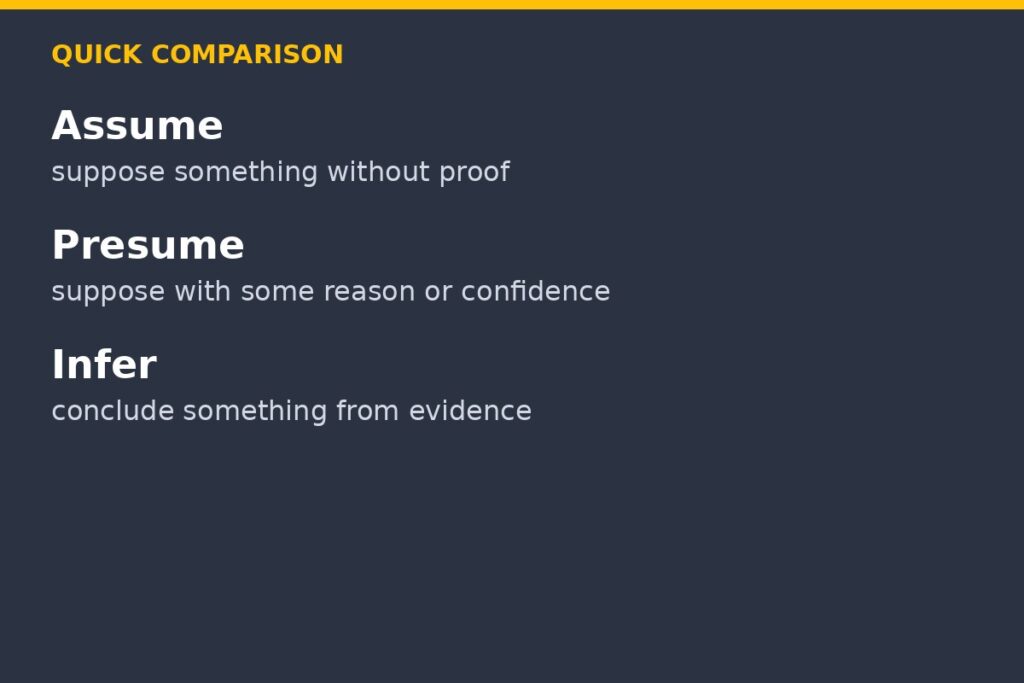
To assume means to accept something as true without checking it and without any proof. When you assume, you simply take an idea into your mind and act as if it is true. There is no evidence behind it — only a guess or a feeling.
People often assume things in daily life: you may assume a shop is open because it usually is, or a friend is busy because she did not reply to your message. In both cases, you do not really know — you just accept the idea.
“Assume” can also mean “to take on” a job or duty, as in “She assumed the role of team leader.” In this guide, we focus on the first meaning: accepting something as true without proof.
Examples of “Assume” in Sentences
- I assumed the train would be late, so I left home early.
- Do not assume he knows the answer — ask him first.
- She assumed the door was locked and did not try to open it.
- We assumed the meeting was cancelled, but it was only delayed.
- He assumed I was angry, but I was just tired.
What Does “Presume” Mean?
To presume means to believe something is true because it is very likely, even if you do not have full proof. Presuming is stronger than assuming. When you presume, you have some reason — past experience, normal practice, or common sense — that makes the idea reasonable.
For example, if your colleague arrives at the office at 9 a.m. every day, you may presume she will arrive at 9 a.m. today too — a fair and sensible belief.
“Presume” also sounds more formal than “assume” and is common in law, business, and official writing — in law, a person is “presumed innocent” until proven guilty. It can also mean to dare to do something: “I would not presume to tell the manager what to do.”
Examples of “Presume” in Sentences
- From your silence, I presume you agree with the plan.
- The court presumes every person innocent until guilt is proven.
- We presume the package will arrive on Friday, as usual.
- I presume you have read the report before this meeting.
- Dr. Rao presumes his patients will follow his advice.
- Given the clear sky, we presume the match will start on time.
What Does “Infer” Mean?
To infer means to reach a conclusion by studying facts, signs, or evidence. When you infer, you do not guess blindly: you look at what you can see, hear, or read, and work out what it probably means.
For example, if you see wet streets in the morning, you infer that it rained during the night. The wet streets are your evidence. Teachers often ask students to infer meaning from a reading passage — to find the answer from clues in the text, not from words printed directly on the page.
Examples of “Infer” in Sentences
- From her red eyes, I inferred that she had been crying.
- Readers can infer the character’s feelings from her actions.
- He inferred from the empty chairs that the class had ended.
- What do you infer from these sales numbers?
- She inferred that he was lying because he avoided her eyes.
- Scientists inferred the age of the rock from its layers.
Bonus Word: What Does “Suppose” Mean?
A fourth word often joins this group: suppose. To suppose means to imagine something or accept it as a possibility, often just for discussion. “Suppose it rains tomorrow — what will we do?” You are not claiming it will rain; you are only imagining the situation.
“Suppose” is weaker and more casual than “assume,” and people use “I suppose so” to agree in a soft, unsure way. Compare the four: you suppose an idea to think about it, you assume it without proof, you presume it because it is likely, and you infer it from evidence.
Infer vs Imply: Implication and Inference
One of the most common English mistakes is confusing infer with imply. They work in opposite directions.
To imply means to suggest something without saying it directly. The speaker or writer implies. To infer means to understand a suggestion from clues. The listener or reader infers.
Think of throwing and catching a ball: the speaker throws a hint — that is the implication — and the listener catches the meaning — that is the inference. So a manager may imply that a project is in trouble, and the team infers from her words that jobs may change. Remember: people imply; listeners infer. You can read more about these verbs in the Merriam-Webster guide to infer vs imply.
Quick Comparison Table
| Word | Basic Meaning | Basis | Strength of Belief | Simple Example |
|---|---|---|---|---|
| Assume | Accept as true without proof | No evidence; a guess | Weak | I assume he is home. |
| Presume | Believe because it is likely | Experience or probability | Fairly strong | I presume he is home — his car is outside. |
| Infer | Conclude from facts or clues | Evidence you can point to | Strongest; reasoned | The lights are on, so I infer he is home. |
| Suppose | Imagine as a possibility | Imagination, discussion | Very weak; just an idea | Suppose he is home — what then? |
Pairwise Differences
Assume vs Presume
Both words mean believing something without full proof, but “presume” rests on a reason: you assume with nothing behind the idea, while you presume because past experience or normal behavior supports it. “Presume” is also more formal.
Assume vs Infer
These two are almost opposites in method. Assuming skips the evidence; inferring starts from it. If you can point to facts that support your belief, you are inferring. If you cannot, you are probably assuming.
Presume vs Infer
A presumption is a belief you hold before checking — your starting point. An inference is a conclusion you reach after looking at clues — your finishing point. Lawyers presume innocence at the start of a trial; the jury infers guilt or innocence from the evidence.
When to Use Each Word: Usage Rules
- Use assume when there is no evidence at all, or when someone takes something for granted without checking.
- Use presume in formal writing, in law, or when probability and past experience make the belief reasonable.
- Use infer when facts, signs, data, or a text lead you to a conclusion.
- Use suppose for imagining a possible situation, often in questions and plans.
- For careful, scientific writing, prefer “infer” and show your evidence.
Word choice matters in exams and essays too. If you enjoy fine differences between similar words, see our guide on neither vs either, another pair that students often confuse.
Common Mistakes to Avoid
- Mistake: “From his tone, I assume he was upset.” Better: “I inferred he was upset.” His tone is evidence, so “infer” is correct.
- Mistake: Using “infer” when you mean “imply.” Remember: speakers imply, listeners infer.
- Mistake: Using “presume” for wild guesses. Presuming needs a reasonable basis.
- Mistake: Writing “I assume so” in a formal report. In formal writing, state your evidence or use “it appears that.”
- Mistake: Treating the four words as exact synonyms. Graders look for these differences.
Tips to Remember
- Assume = accept blindly. No proof, no checking.
- Presume = probably true. Likely, based on experience.
- Infer = evidence first. Clues lead to the conclusion.
- Suppose = imagine it. Just an idea for discussion.
- Ask one question: “What is my belief based on?” The answer picks the word.
Self-Check Quiz
Choose the best word for each sentence.
- There is no information about the new manager yet, so I simply _____ that she will start on Monday. (assume / infer)
- The streets are wet and umbrellas are everywhere, so I _____ that it rained. (assume / infer)
- In court, a person is _____ innocent until proven guilty. (assumed / presumed)
- _____ the bridge closes tonight — how will we reach the airport? (Assume / Suppose)
- From the smoke over the hills, villagers _____d that a fire had started. (infer)
Answers
- assume — there is no evidence.
- infer — wet streets and umbrellas are evidence.
- presumed — the legal, formal word based on principle.
- Suppose — an imagined situation for planning.
- inferred — smoke is a clue that leads to a conclusion.
Frequently Asked Questions
What is the main difference between assume and presume?
An assumption has no basis at all, while a presumption rests on probability or past experience. “Presume” is also more formal and common in law and official writing.
Can “infer” and “imply” be used in the same way?
No. To imply is to suggest something; to infer is to understand a suggestion from clues. The speaker implies, and the listener infers.
Is “assume” a negative word?
Not always, but it can carry a warning: saying “you assumed” suggests someone acted without checking. In neutral uses, like “assume the position,” it simply means “take on.”
Which word should I use in academic writing?
“Infer” is safest when you present evidence and draw a conclusion. Avoid “assume” unless you openly state it as an assumption of your study.
What is the difference between presume and suppose?
“Presume” means you believe something is likely true. “Suppose” only imagines a possibility, often to discuss it: “Suppose we leave early.”
How can I remember these words easily?
Use the evidence test. No evidence: assume. Likely from experience: presume. Evidence and clues: infer. Pure imagination: suppose.
Final Conclusion
The difference between assume, presume, and infer comes down to one thing: evidence. You assume without proof, presume because something is likely, and infer because facts lead you there. Add “suppose” for imagined possibilities, and keep “imply” separate — speakers imply, listeners infer. With a little practice, you will choose the right word every time. For another tricky choice explained step by step, read our guide to annual vs yearly vs every year.