Piece of Mind or Peace of Mind: Which Is Correct?
Piece of mind or peace of mind — which one is correct? The two phrases sound exactly the same when you speak, but only one of them is the standard English phrase. The correct phrase is peace of mind. It means a feeling of calm, safety, and freedom from worry. Piece of mind, written with “piece,” is almost always a spelling mistake.
There is one twist, though. English also has a completely different idiom: to give someone a piece of your mind. That idiom is real and correct — but it means something very different: to tell someone angrily what you think of them. In this guide, you will learn the peace of mind meaning and the peace of mind definition in simple words, why “piece of mind” is wrong, how the “piece of my mind” idiom works, clear examples of both, and simple tricks so you never mix them up.
The Short Answer: Peace of Mind Is the Correct Phrase
If you want to say that someone feels calm and free from worry, always write peace of mind. The key word is peace, which means calm and quiet, the opposite of war and noise. Your mind feels “at peace.”
Piece, on the other hand, means a part or a fragment of something — a piece of cake, a piece of paper, a piece of the puzzle. A “piece of mind” would mean a small part cut from your brain, which is not what anyone wants to say. That is why dictionaries and style guides accept only “peace of mind” as the standard phrase.
What Does “Peace of Mind” Mean?
Peace of mind is a noun phrase. It means a feeling of being calm, safe, and not worried, because you know that a possible problem is taken care of. The Cambridge Dictionary definition of peace of mind describes it as freedom from worry, and that is exactly how people use it every day.
People usually get peace of mind from things that protect them or help them feel prepared:
- Insurance: “Home insurance gives us peace of mind.”
- Checking and preparing: “She locked the door twice for peace of mind.”
- Good news about health: “The test results gave him real peace of mind.”
- Savings and planning: “An emergency fund brings peace of mind.”
Words with a similar meaning include calm, reassurance, comfort, and relief. The opposite feelings are stress, worry, and anxiety. If a sentence is about removing worry, the phrase you need is “peace of mind.”
What Does “Piece of Mind” Mean?
Taken word by word, piece of mind would mean “a part of the mind or brain.” Nobody uses it that way in normal English. When you see “piece of mind” in writing, it is nearly always a typing or spelling error made by someone who heard the phrase spoken and wrote what they heard.
There is no common phrase “a piece of mind” that means calm. If you write “This alarm gives me piece of mind,” readers will understand you, but they will also notice the mistake. In exams, job applications, and professional emails, that small error can make your writing look careless.
“Give Someone a Piece of My Mind”: A Different Idiom
Now for the exception. English has a well-known idiom: to give someone a piece of your mind. It means to speak to someone angrily and honestly, telling them exactly what you think about something bad they did. Here, “piece” is correct — you are handing over a “piece” (a part) of your thoughts.
- “The noise kept me awake all night, so I went downstairs and gave my neighbour a piece of my mind.”
- “She was tired of his lies and finally gave him a piece of her mind.”
Notice the pattern: the idiom needs a possessive word — my, her, his, their — and a verb like give or tell. It is always about anger and honest opinions. So remember: a piece of my mind = an angry opinion; peace of mind = a calm feeling. The two phrases are opposites in mood, even though they sound the same.
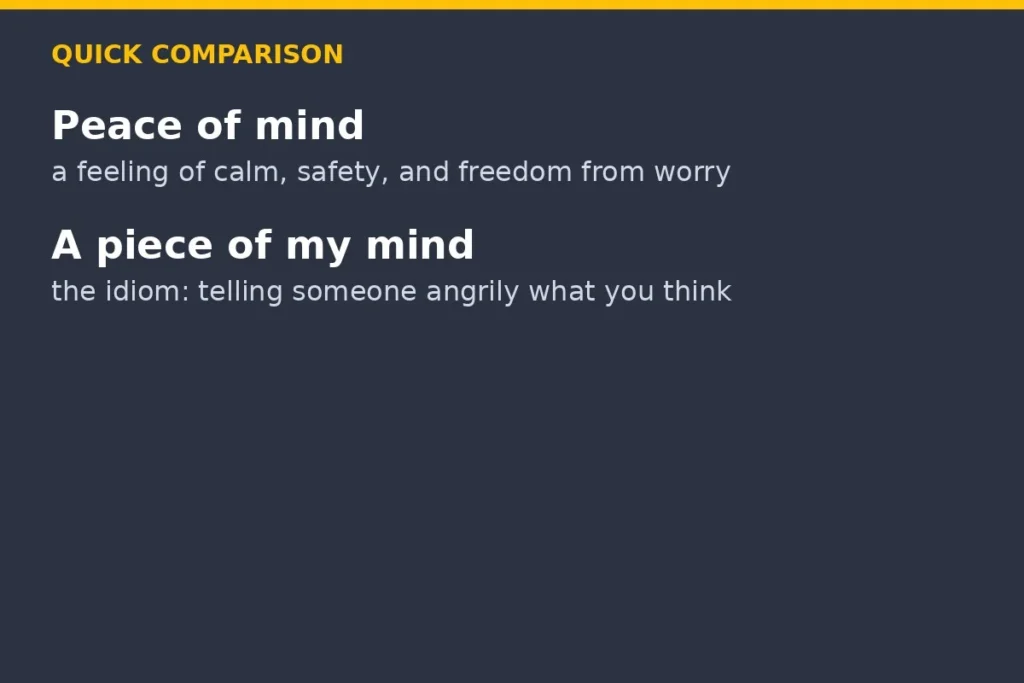
Quick Comparison: Peace of Mind vs Piece of Mind
| Point | Peace of Mind | Piece of Mind |
|---|---|---|
| Correct? | Yes — the standard phrase | No — almost always a mistake |
| Meaning | Calm, safety, freedom from worry | Would mean “a part of the brain” (not used) |
| Key word | Peace = calm (like peace after war) | Piece = a part or fragment (a piece of cake) |
| Feeling | Relaxed, safe, comfortable | — |
| Example | The warranty gives me peace of mind. | ✗ The warranty gives me piece of mind. |
| Related idiom | — | To give someone a piece of your mind = to tell them angrily what you think |
Examples of “Peace of Mind” in Sentences
- Buying travel insurance gave us peace of mind during the whole trip.
- For your peace of mind, please keep your passport in the hotel safe.
- The doctor said the results were normal, which gave her great peace of mind.
- He checks on his elderly mother every evening for his own peace of mind.
- A good lock on the door brings peace of mind to the whole family.
- Saving a little money each month gives me peace of mind about the future.
- The babysitter sent photo updates so the parents could enjoy dinner with peace of mind.
Examples of “A Piece of My Mind” in Sentences
- When the mechanic charged me twice, I went back and gave him a piece of my mind.
- Mum found the broken window and gave us a piece of her mind.
- He keeps arriving late, and one day the manager will give him a piece of her mind.
- I wanted to give the rude customer a piece of my mind, but I stayed professional.
- After the team lost because of his careless mistake, the coach gave him a piece of his mind.
Peace of Mind in Different Contexts
Insurance, Money, and Safety
This is the most common context. Companies use “peace of mind” because their products remove worry: insurance, warranties, alarm systems, and savings plans. “This alarm system gives you complete peace of mind while you sleep.”
Health
After tests, check-ups, or treatment, good news brings peace of mind. People also use it for healthy habits: “Knowing my blood pressure is normal gives me peace of mind.”
Travel and Family
Travellers want peace of mind about flights, hotels, and documents. Parents want it about their children. Any time someone checks something “just to be sure,” they are doing it for peace of mind.
Speaking Your Mind (The Other Idiom)
“A piece of my mind” belongs to arguments and honest complaints. It is strong and a little rude, so use it carefully. It never means calm — it means the opposite mood. Sound-alike pairs like this are common in English; our guide to sale vs sail explains another famous one.
How to Pronounce Both Phrases
You cannot hear the difference: peace and piece are homophones, pronounced exactly the same (/piːs/). The whole phrase sounds like “PEESS of MYND.” Both phrases are noun phrases, but only “peace of mind” works as a standard phrase on its own. Because your ears cannot help you, you must choose the spelling by meaning, not by sound.
Why People Confuse These Phrases
The confusion is natural. English is full of homophones — words that sound alike but are spelled differently, like there/their and your/you’re. When we write quickly, we often write what we hear in our head. “Piece” is also a very common, familiar word, so the brain reaches for it first. The fix is simple: stop and ask, “Do I mean calm, or do I mean a part?” The answer tells you the spelling.
Common Mistakes to Avoid
- Writing “piece of mind” for calm: ✗ “The warranty gives me piece of mind.” → ✔ “The warranty gives me peace of mind.”
- Writing “peace of my mind” for the angry idiom: ✗ “I gave him a peace of my mind!” → ✔ “I gave him a piece of my mind!”
- Forgetting the possessive in the idiom: ✗ “I gave him a piece of mind.” → ✔ “I gave him a piece of my mind.”
- Using the angry idiom when you mean calm: ✗ “The insurance gave the driver a piece of his mind.” → ✔ “The insurance gave the driver peace of mind.”
- Trusting your ears: The two phrases sound identical. Always check the meaning, never the sound.
Tricks to Remember
- Peace = calm. Think of peace after a war: quiet and safe. If the feeling is calm, choose peace.
- The “ease” trick: Peace contains the letters for ease — and peace of mind puts your mind at ease.
- Piece = part. A piece is a part of something solid, like a piece of cake. You cannot cut a piece out of a feeling.
- The anger test: If someone is angry and speaking honestly, it is a piece of my mind. If someone feels calm and safe, it is peace of mind.
Self-Check Quiz
- A smoke alarm in every room gives the family ______ (piece of mind / peace of mind).
- When the builders left rubbish everywhere, Dad went outside to give them ______ (a piece of his mind / peace of mind).
- She double-checked the tickets for her own ______ (piece of mind / peace of mind).
- “One day I will tell that rude driver ______ !” (a piece of my mind / peace of mind)
- True or false: “Piece of mind” is the correct phrase for feeling calm.
Answers: 1. peace of mind (a calm, safe feeling) 2. a piece of his mind (an angry, honest opinion) 3. peace of mind (freedom from worry) 4. a piece of my mind (the idiom always has my/his/her) 5. False — “peace of mind” is correct.
Frequently Asked Questions
Is it “peace of mind” or “piece of mind”?
It is “peace of mind.” That is the only correct spelling for the feeling of calm and freedom from worry. “Piece of mind” is a common spelling error, because the two phrases sound exactly the same when spoken. What is the difference between piece of mind and peace of mind? “Peace of mind” is the real phrase; “piece of mind” is simply the mistake. And if you ever wonder how do you spell piece of mind correctly — the correct spelling uses “peace,” the word for calm.
What does “peace of mind” mean?
It means a feeling of calm, safety, and comfort because you are not worried about a problem. People often use it for insurance, health results, money saved, and anything else that removes worry.
What does “give someone a piece of my mind” mean?
It is an idiom that means to tell someone angrily and honestly what you think about something they did wrong. For example: “The driver blocked my gate again, so I gave him a piece of my mind.” It is about anger, not calm.
Can “piece of mind” ever be correct?
Only inside the idiom “a piece of my/his/her mind,” where “piece” means a part of your thoughts that you hand to someone in anger. On its own, “piece of mind” is not a standard phrase and should be avoided.
Do “peace of mind” and “piece of mind” sound the same?
Yes, they are pronounced identically, because “peace” and “piece” are homophones. That is exactly why the mistake is so common in writing. You have to choose by meaning: calm = peace, a part = piece.
Is “peace of mind” formal or informal English?
It works in both. You will see it in formal places like insurance contracts and hospital letters, and in everyday speech like “Lock the car, for peace of mind.” It is a safe, natural phrase in any situation.
Final Conclusion
The rule is simple: for a calm mind, write peace of mind — never “piece of mind.” Keep “piece” for real parts of things, and for the one idiom where it belongs: giving someone a piece of your mind when you are angry. Meaning first, sound second, and you will get this phrase right every time.
Sound-alike words cause many English mistakes. Keep practising with our guides to assume vs presume vs infer and other confusing pairs.