
Did You Had or Did You Have: Which Is Correct?
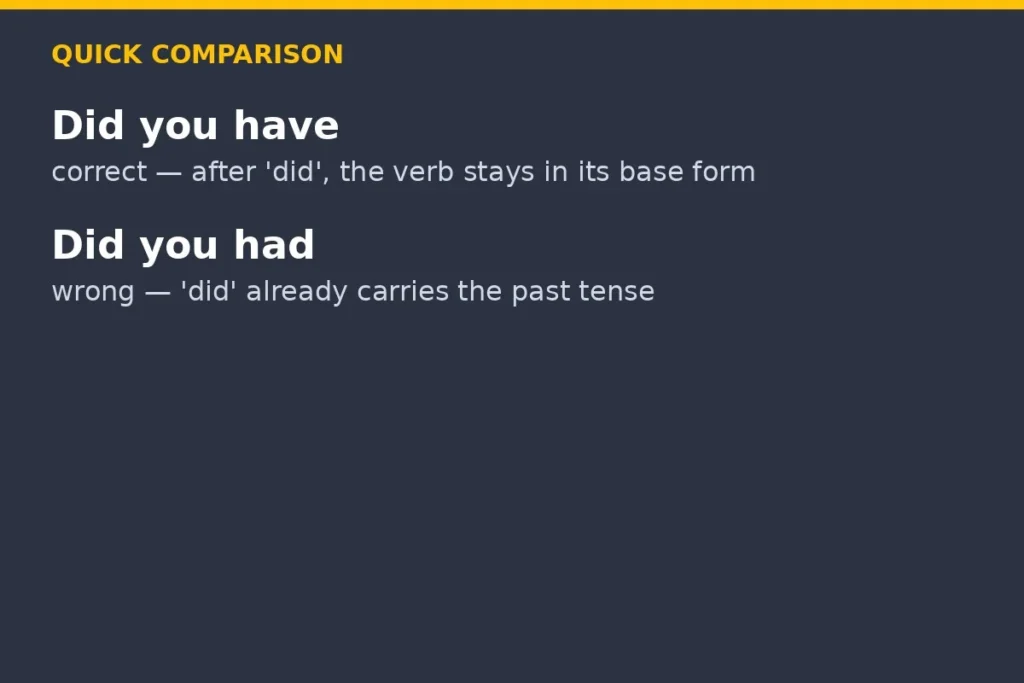
Should you say “Did you had” or “Did you have”? The short answer is simple: “Did you have” is always correct, and “Did you had” is always wrong. There is one easy rule behind it: after did, always use the base form of the verb. The base form of “had” is “have,” so the question must be “Did you have…?”
In this guide, you will learn why this rule works, how to build past-tense questions with “did,” how the rule works with every other verb, how “Did you have” differs from “Have you had,” common mistakes, and a short quiz.
The Rule: After “Did,” Always Use the Base Form
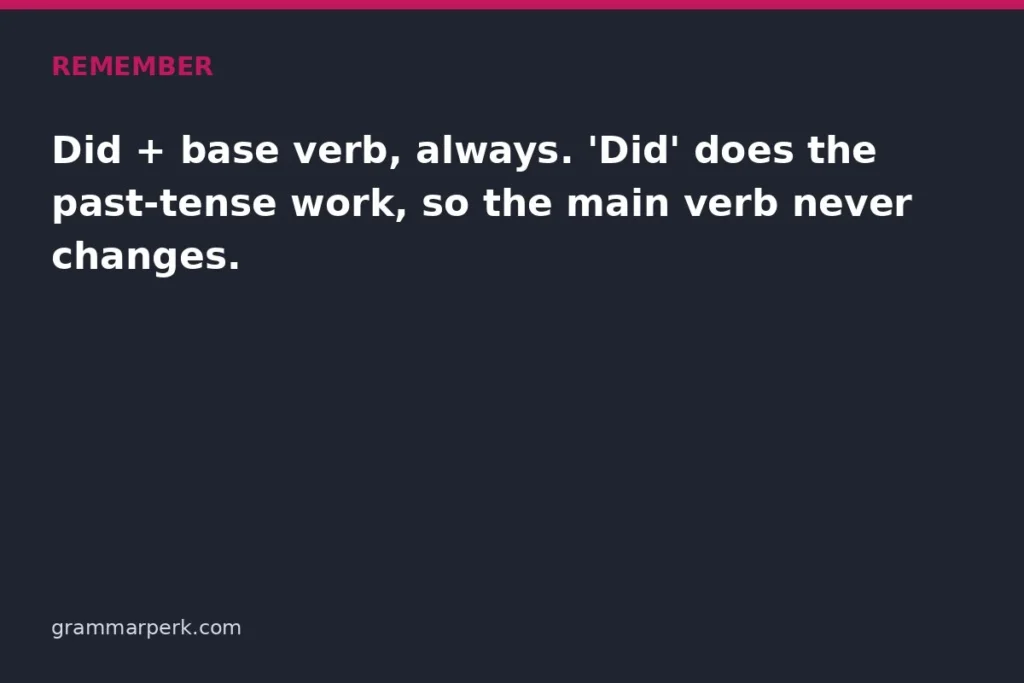
English verbs change shape to show time. “Have” is the present form, and “had” is the past form: “I have time today,” but “I had time yesterday.” When you ask a question about the past, the little helper verb did carries the past tense for the whole sentence. Because “did” already does that job, the main verb goes back to its base form — its simplest form, the one you find in a dictionary.
Think of it like this: one sentence needs only one past-tense marker. In “Did you have lunch?”, the word “did” is the marker. If you write “Did you had lunch?”, you have marked the past twice — once with “did” and once with “had.” English does not allow that double past, so “did you had” is a grammar error in every situation.
Why “Did” Already Shows the Past
“Did” is the past tense of “do.” According to Merriam-Webster’s dictionary entry for “did”, “did” is simply the past form of the verb “do.” That is the whole secret: the moment “did” appears in your question, the listener already knows you are talking about the past. The main verb is then free to stay in its base form, because its only job is to name the action.
- “Do you have time?” (present) → “Did you have time?” (past)
- “Does she have a car?” (present) → “Did she have a car?” (past)
- “Do they have the keys?” (present) → “Did they have the keys?” (past)
Notice that only “do/does” changes into “did.” The verb “have” never changes.
What Is the Base Form of “Have”?
Every verb has three main forms. For “have,” they are:
- Base form: have — “I want to have a break.”
- Past form: had — “We had a break at noon.”
- Past participle: had — “We have had a long day.”
After “did,” you always need the first one — the base form. This is true for every verb, not just “have.” Verb forms confuse many learners; our guide to headed vs heading explains another pair of forms that people mix up.
Quick Comparison: Did You Had vs Did You Have
| Point | Did you have ✔ | Did you had ✗ |
|---|---|---|
| Correct? | Yes, always | No, never |
| Verb form after “did” | Base form (have) | Past form (had) |
| Past-tense markers | One (“did”) | Two (“did” + “had”) — a double-past error |
| Example | Did you have a good trip? | Did you had a good trip? ✗ |
| Use it in exams and formal writing? | Yes | Never |
How to Build Past-Tense Questions with “Did”
Past-tense questions with “did” follow one fixed pattern that never changes:
Did + subject + base verb + rest of the question?
- Start with Did.
- Add the subject (you, he, she, they, the teacher…).
- Add the base verb (have, go, eat, see, finish…).
- Finish the question and add a question mark.
Watch the pattern work:
- Did + you + have + a good weekend?
- Did + she + have + enough money?
- Did + they + finish + the work on time?
- Did + he + call + you yesterday?
The beautiful thing about this pattern is that it works for every subject. With present-tense questions you must choose between “do” and “does,” but in the past there is only “did” — for I, you, he, she, it, we, and they alike.
Examples of “Did You Have” in Sentences
“Did you have” is one of the most common questions in everyday English. Here are natural examples, grouped by topic.
Asking About Past Events
- Did you have a meeting yesterday?
- Did you have an exam last week?
- Did you have time to call her?
- Did you have a party for your birthday?
- Did you have class this morning?
Asking About Possessions and Situations
- Did you have a car when you lived in London?
- Did you have enough money for the ticket?
- Did you have any problems with the car?
- Did you have a phone back then?
Asking About Experiences and Feelings
- Did you have fun at the wedding?
- Did you have a good sleep?
- Did you have any idea about the surprise?
- Did you have trouble finding the house?
You will hear questions like these in films and daily conversation — and they always use “have,” never “had.”
The Same Rule with Other Verbs: Did + Base Form
“Have” is not special. The did + base verb rule applies to every verb in English. Many learners make the same double-past mistake with other verbs, so learn the pattern once and use it everywhere:
- ✔ Did you go to school today? — ✗ Did you went…?
- ✔ Did she eat breakfast? — ✗ Did she ate…?
- ✔ Did they see the film? — ✗ Did they saw…?
- ✔ Did he take the bus? — ✗ Did he took…?
- ✔ Did it rain last night? — ✗ Did it rained…?
- ✔ Did you buy the tickets? — ✗ Did you bought…?
Negatives: “Didn’t” + Base Form
Negative sentences follow exactly the same rule. Use “did not” (or the short form “didn’t”) and keep the main verb in its base form:
- ✔ I didn’t have time to finish.
- ✗ I didn’t had time to finish.
- ✔ She did not have my number.
- ✗ She did not had my number.
- ✔ They didn’t go to the meeting.
- ✔ We didn’t see anyone there.
Short Answers with “Did”
When someone asks you a “did” question, the short answer also uses “did” — never the main verb:
- “Did you have lunch?” → “Yes, I did.” / “No, I didn’t.”
- “Did she have the keys?” → “Yes, she did.”
- ✗ “Yes, I had.” is wrong as a short answer to a “did” question — say “Yes, I did.”
“Did” for Emphasis
There is one more place where “did + base form” appears: in positive statements, to add emphasis or to correct someone. Here, too, the base form is used:
- “You didn’t call me!” — “I did call you — twice!”
- He did have a ticket, but he lost it.
- We did finish the work, just like we promised.
“Did You Have” vs “Have You Had”: What’s the Difference?
Learners often ask: if “had” is wrong after “did,” why is “Have you had…?” correct? The answer is that these are two different tenses built in two different ways.
“Did you have” is the simple past. It asks about a finished time — yesterday, last week, when you were a child. The time is over and closed.
“Have you had” is the present perfect. Here, “have” is the helper verb, and “had” is the past participle that follows it. This tense asks about experience or about a period of time that continues up to now — “today,” “this week,” “in your life.”
So “had” is perfectly correct after “have” (Have you had…?), but never after “did” (Did you had…?). The helper verb decides which form the main verb takes.
| Structure | Tense | Meaning | Example |
|---|---|---|---|
| Did you have…? | Simple past | A finished time in the past | Did you have breakfast yesterday? |
| Have you had…? | Present perfect | Experience, or time up to now | Have you had breakfast today? |
| Did you had…? | — | Always wrong | ✗ Never use this |
More pairs to feel the difference:
- Did you have a car last year? (that year is finished) / Have you ever had a car? (in your life up to now)
- Did you have this dish at the party? / Have you had this dish before?
Correct and Incorrect Examples
- ✗ Did you had a good day? → ✔ Did you have a good day?
- ✗ Did she had any questions? → ✔ Did she have any questions?
- ✗ I didn’t had enough money. → ✔ I didn’t have enough money.
- ✗ Did they went home early? → ✔ Did they go home early?
- ✗ You had fun? → ✔ Did you have fun? (a full question needs “did”)
- ✗ “Did you have time?” — “Yes, I had.” → ✔ “Yes, I did.”
Common Mistakes to Avoid
- The double past: “Did you had,” “Did you went,” “Did she ate.” Fix: after “did,” always use the base form.
- Forgetting “did”: “You had lunch?” works only as an informal echo question with a surprised voice. In normal questions — and always in writing and exams — start with “Did.”
- Using “had” after “didn’t”: The rule covers negatives too: “I didn’t have,” never “I didn’t had.”
- Answering with the main verb: Short answers repeat “did”: “Yes, I did,” not “Yes, I had.”
- Mixing the two tenses: Use “Did you have…?” with finished time words (yesterday, last week, ago), and “Have you had…?” for experience and time up to now. Never blend them into “Did you had.”
Tips to Remember
- One past marker is enough. If “did” is in the sentence, the past is already marked — keep the main verb simple.
- “Did eats the past.” Imagine “did” swallowing the past ending of the next verb: went → go, ate → eat, had → have.
- Check with “go”: If you are unsure, test the sentence with “go/went.” You would never say “Did you went,” so never say “Did you had” either.
- The dictionary test: After “did,” use the form you would find as the first entry in a dictionary — the base form.
Quick Self-Check Quiz
Choose the correct option in each question.
- ______ you have a good trip last month? (Did / Do)
- Did she ______ her umbrella? (had / have)
- I didn’t ______ any money with me. (had / have)
- Did they ______ the match yesterday? (won / win)
- “Did you have fun?” — “Yes, I ______.” (had / did)
Answers: 1. Did (last month is a finished past time) 2. have (base form after “did”) 3. have (base form after “didn’t”) 4. win (base form — “won” would be a double past) 5. did (short answers repeat “did”)
Frequently Asked Questions
Why is “Did you had” incorrect?
Because “did” already marks the past tense. Adding “had,” which is also a past form, creates a double past, and English allows only one past-tense marker. After “did,” the main verb must stay in its base form: “Did you have.”
Is “Did you had” ever correct in any situation?
No. “Did you had” is never correct in standard English — not in speech, not in writing, not in any dialect used in exams or formal communication. The correct form is always “Did you have.”
When should I use “Did you have”?
Use “Did you have” to ask about a finished action, event, possession, or situation in the past: “Did you have a meeting yesterday?” “Did you have a car at university?” If you can point to a finished time, “did” is the right choice.
What is the difference between “Did you have” and “Have you had”?
“Did you have” (simple past) asks about a closed, finished time: “Did you have lunch yesterday?” “Have you had” (present perfect) asks about experience or a period that reaches the present: “Have you had lunch today?” Note that “had” follows “have” here as a past participle — that is why it is correct in this structure but wrong after “did.”
How do I make negative sentences with “did”?
Use “did not” or “didn’t” plus the base form: “I didn’t have time,” “She did not have the address.” The rule never changes — after any form of “did,” the main verb stays in its base form.
Can I use “Did you have” in formal writing?
Yes. “Did you have” is fully correct in both formal and informal English, including business emails, exams, and academic writing. It is “did you had” that would look like an error anywhere.
Final Conclusion
The choice between “did you had” and “did you have” is one of the easiest in English grammar once you know the rule: “did” already carries the past tense, so the main verb always stays in its base form. That gives you “Did you have…?”, “Did you go…?”, “I didn’t have…”, and “Yes, I did” — a single pattern that works with every verb, every subject, and every past question. Trust the pattern, practise with the examples above, and the double-past mistake will disappear from your English for good.
Verb forms and word choices trip up every learner — keep practising with our guides to assume vs presume vs infer and neither vs either.