My Wife and I or My Wife and Me: Which One Is Correct?
Should you say “my wife and I” or “my wife and me”? Both phrases are correct — but never in the same sentence. One of them belongs at the start of a sentence, doing the action, and the other belongs after the verb, receiving the action. Mixing them up is one of the most common grammar mistakes in English — usually made by people trying too hard to sound formal.
In this guide, you will learn the simple subject and object rule, an easy two-second test, correct and incorrect examples, and the mistakes to avoid — including the famous “between you and I” error.
Quick Answer: The Simple Rule
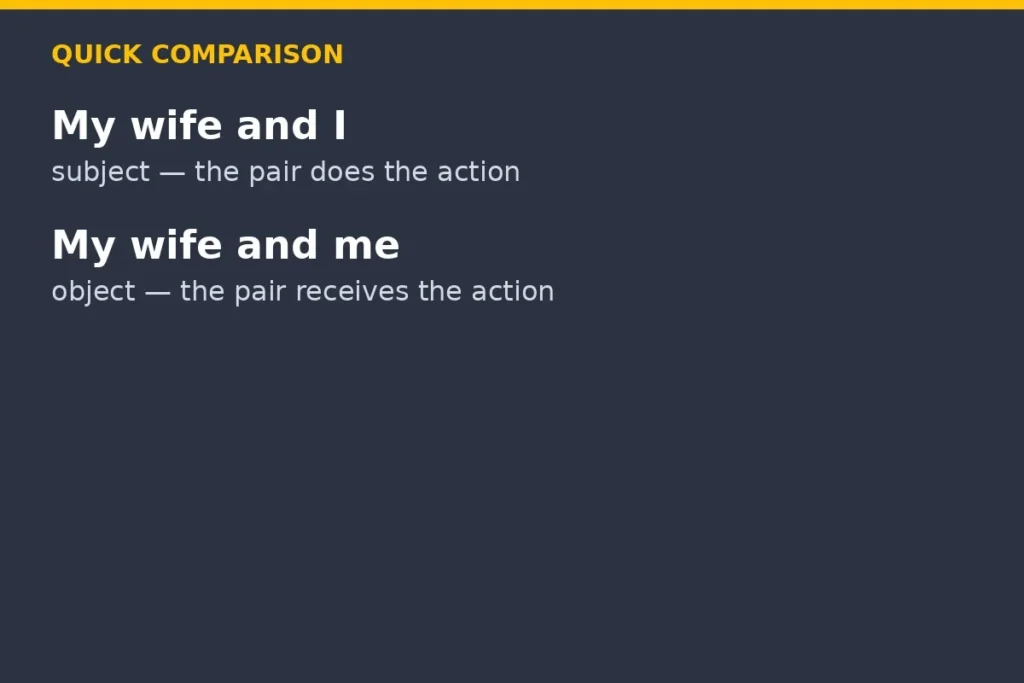
- Use “my wife and I” when you and your wife are the subject doing the action: “My wife and I live in Texas.”
- Use “my wife and me” when you and your wife are the object — receiving the action, or following a preposition such as for, to, with, or between: “He gave the keys to my wife and me.”
That is all you need. “My wife and I” is not “more correct” in every situation — it is simply the subject form, and using it as an object is a mistake, even though it sounds fancy. The rest of this article explains the rule slowly, with examples.
Subject and Object Pronouns: The Basics
English personal pronouns change form depending on their job in the sentence. A pronoun that does the action is a subject pronoun; one that receives the action is an object pronoun. “I” is a subject pronoun and “me” is an object pronoun — two forms of the same person.
Here are the pairs you use every day:
- I / me — “I called her.” / “She called me.”
- He / him — “He smiled.” / “I saw him.”
- She / her — “She left early.” / “We thanked her.”
- We / us — “We won the game.” / “They joined us.”
- They / them — “They are ready.” / “Please ask them.”
Nobody says “Me called her” or “She called I” — alone in a sentence, the right form feels automatic. The confusion starts only when a second person joins with “and”: “my wife and ___.” Your brain stops checking the grammar and starts guessing. The Cambridge Dictionary guide to personal pronouns shows the same forms — the job in the sentence, not politeness, decides which one you need.
Adding “my wife and” does not change the grammar at all: “my wife and I” behaves exactly like “I” alone, and “my wife and me” like “me” alone. That simple fact gives us the famous drop test, below.
When to Use “My Wife and I” (Subject)
Use “my wife and I” when the two of you are doing the action of the verb. The phrase normally comes before the verb.
- My wife and I are travelling to Chicago tomorrow.
- My wife and I bought our house in 2019.
- My wife and I agree with the decision.
- My wife and I run a small bakery together.
- My wife and I were invited to the wedding.
Swap in “my wife and me” and you will feel the mistake at once: “My wife and me are travelling” is wrong in the same way “Me is travelling” is wrong.
When to Use “My Wife and Me” (Object)
Use “my wife and me” when the pair receives the action of a verb, or follows a preposition.
After a verb (receiving the action)
- The teacher called my wife and me into the office.
- She invited my wife and me to her birthday.
- They thanked my wife and me for the help.
After a preposition (for, to, with, between, about, from)
- This gift is for my wife and me.
- He spoke to my wife and me after the meeting.
- The secret stays between my wife and me.
Prepositions always take the object form — which is why “between my wife and I” is wrong: “between” must be followed by “me,” never “I.”
Quick Comparison: My Wife and I vs My Wife and Me
| Point | My Wife and I | My Wife and Me |
|---|---|---|
| Grammar job | Subject — does the action | Object — receives the action |
| Pronoun form | “I” = subject pronoun | “me” = object pronoun |
| Usual position | Before the verb | After the verb, or after a preposition |
| Example | My wife and I are ready. | She invited my wife and me. |
| Short test | Remove “my wife and” → “I am ready.” | Remove “my wife and” → “She invited me.” |
The Drop Test: Take Out “My Wife” and Check
Here is the fastest, most reliable trick in this whole topic:
- Take “my wife and” out of the sentence.
- Read the sentence with only “I” or “me” in the gap.
- Keep the form that sounds right — it is the correct one. Then put “my wife and” back in front of it.
Watch the test work:
- “___ went to the market.” → “I went” ✔ (not “Me went”) → My wife and I went to the market.
- “He gave the tickets to ___.” → “He gave the tickets to me” ✔ (not “to I”) → He gave the tickets to my wife and me.
- “___ were late for the train.” → “I was late” ✔ → My wife and I were late for the train.
The drop test works because “my wife and” is only a passenger in the sentence — it never changes which pronoun form the grammar needs.
Correct and Incorrect Examples
Train your eye with these pairs — the wrong sentences are real mistakes native speakers make daily.
- ✔ My wife and I are planning a trip. / ✗ My wife and me are planning a trip.
- ✔ They sent my wife and me a card. / ✗ They sent my wife and I a card.
- ✔ This photo of my wife and me was taken in Paris. / ✗ This photo of my wife and I was taken in Paris. (“Of” is a preposition — object form.)
- ✔ My wife and I would love to come. / ✗ Me and my wife would love to come. (Informal only — see below.)
- ✔ Keep this between my wife and me. / ✗ Keep this between my wife and I.
- ✔ For my wife and me, Sundays are for family. / ✗ For my wife and I, Sundays are for family.
Word Order: Why Your Wife Comes First
English has a politeness habit: mention the other person before yourself. Say “my wife and I,” not “I and my wife.” “I and my wife went” uses the correct subject pronoun, but it sounds stiff and selfish to native ears, so almost nobody says it.
What about “me and my wife”? People often ask it as a straight choice — me and my wife or my wife and I. You will hear “me and my wife” constantly in films, songs, and casual talk: “Me and my wife went out yesterday.” In relaxed speech it is normal. But it breaks two habits at once — it puts you first and uses the object form as a subject — so keep it out of formal writing, job applications, exams, and professional emails.
Choosing between two forms is a common English problem — our guide to neither vs either explains another such choice step by step.
Common Mistakes to Avoid
- Using “my wife and I” everywhere to sound formal. This is the number-one mistake, called overcorrection (or hypercorrection). Many people were told as children that “me” is rude or wrong, so they avoid it completely. Result: “He spoke to my wife and I” — wrong. “Me” is a perfectly good word; it is simply the object form.
- Saying “between you and I.” “Between” is a preposition and takes objects: “between you and me.” The “I” version is common in songs and films, but in careful English it is an error.
- Using “myself” to sound polite. “Please contact my wife or myself” and “My wife and myself attended” are both wrong. “Myself” is reflexive: use it only when the subject and object are the same person (“I taught myself French”) or for emphasis. The correct sentence is “Please contact my wife or me.”
- Trusting your ear after “and.” “My wife and I” is repeated so often as a fixed chunk that it feels unchangeable. Break the chunk with the drop test instead.
Formal vs Informal: Writing vs Speech
In formal writing — business emails, essays, wedding speeches, exam answers — follow the rule strictly and always put your wife first:
- “My wife and I are delighted to accept your invitation.”
- “The award was presented to my wife and me.”
In informal speech with friends and family, native speakers relax the word order (“Me and my wife grabbed a pizza”) and nobody minds. Spoken English is flexible. But the moment you write for work, school, or a special occasion, switch back to the careful forms. A good rule of thumb: if you would dress smartly for the occasion, dress your grammar smartly too.
Tips to Remember
- The drop test never lies. If “I” works alone, use “my wife and I”; if “me” works, use “my wife and me.”
- Preposition = “me.” After for, to, with, between, about, or from, always choose “my wife and me.”
- Verb after the pair? “I.” Verb acting on the pair? “Me.” (“My wife and I left.” / “He called my wife and me.”)
- Wife first, always. “Me and my wife” and “I and my wife” both sound unpolished; the polite order costs nothing.
- Do not fear “me.” Using “me” correctly is not bad manners — using “I” wrongly is the real mistake. Small form choices matter everywhere; our headed vs heading guide shows another pair where one small ending changes everything.
Self-Check Quiz
Choose the correct form in each sentence, then check the answers below.
- ___ are cooking dinner tonight. (My wife and I / My wife and me)
- She spoke to ___ after the show. (my wife and I / my wife and me)
- The gift was for ___. (my wife and I / my wife and me)
- ___ went to the cinema together. (My wife and I / My wife and me)
- They called ___ yesterday evening. (my wife and I / my wife and me)
- Just between you and ___, the plan is a secret. (I / me)
Answers: 1. My wife and I (subject) 2. my wife and me (after “spoke to”) 3. my wife and me (after “for”) 4. My wife and I (subject) 5. my wife and me (object of “called”) 6. me (after the preposition “between”)
Frequently Asked Questions
Is it “my wife and I” or “my wife and me”?
Asked the other way round — is it my wife and me or my wife and I? — the answer is that both are correct in different sentences. Use “my wife and I” when the pair is the subject (“My wife and I live here”), and “my wife and me” when it is the object or follows a preposition (“He wrote to my wife and me”). The drop test — removing “my wife and” — always shows which one you need.
Why is “between you and I” wrong?
Because “between” is a preposition, and prepositions must be followed by object pronouns: me, him, her, us, them. So the correct form is “between you and me.” People say “between you and I” because they were taught “I” is the polite word — but politeness does not change grammar.
Is “me and my wife” grammatically wrong?
In formal English, yes. It uses the object pronoun “me” as a subject and puts you before your wife, breaking the politeness order. In casual speech it is extremely common and sounds natural, but in writing use “my wife and I” for a subject and “my wife and me” for an object.
Can I say “my wife and myself” instead?
No. “Myself” is reflexive and only works when the subject and object are the same person, as in “I introduced myself.” Sentences like “My wife and myself went” or “Contact my wife or myself” are incorrect — use “I” or “me” by the normal rule.
How does the drop test work exactly?
Remove “my wife and” and try the sentence with just “I” or just “me.” Whichever sounds correct alone is correct in the full sentence: “He invited ___” gives “He invited me,” so the full sentence is “He invited my wife and me.” It works in almost every sentence.
Which form should I use in a formal email or a wedding speech?
Use the strict rule and put your wife first: “My wife and I would like to thank you” (subject) and “Thank you for joining my wife and me” (object). Avoid “me and my wife,” “between you and I,” and “myself” — the three errors careful listeners notice most.
Final Conclusion
My wife and I or my wife and me is not a question of which phrase is “better” — it is a question of grammar job. Subjects take “my wife and I”; objects and phrases after prepositions take “my wife and me.” When unsure, drop “my wife and” and listen to whether “I” or “me” sounds right. Add the politeness habit — wife first — and leave “myself” for true reflexive sentences, and you will get this right every time.