45 Similes for Problems: Clear Examples Explained Simply
Problems are hard to explain. How big is the trouble? How does it feel? Writers use similes for problems to compare a difficulty to something familiar — a tangled knot, a storm, a heavy chain — so readers instantly understand its size and weight.
Below are 50 similes for problems in five categories, each with a short meaning and an example sentence for your essays, stories, speeches, and everyday writing.
What Is a Simile?
A simile compares two different things using the words like or as. “The problem was like a maze” compares a difficulty to a maze because both are confusing and hard to escape. As Britannica’s definition of a simile shows, this comparison helps readers picture one thing through another. Similes for problems borrow images from weather, weight, damage, and blocked paths.
Top 10 Similes for Problems
Short on time? Start with these ten favourites:
- Like a tangled knot.
- Like a confusing maze.
- Like a ticking time bomb.
- Like a sinking ship.
- Like heavy chains.
- Like a sudden storm.
- Like a steep mountain.
- Like a dead-end road.
- Like a spreading wildfire.
- Like sinking quicksand.
Similes for Confusing Problems
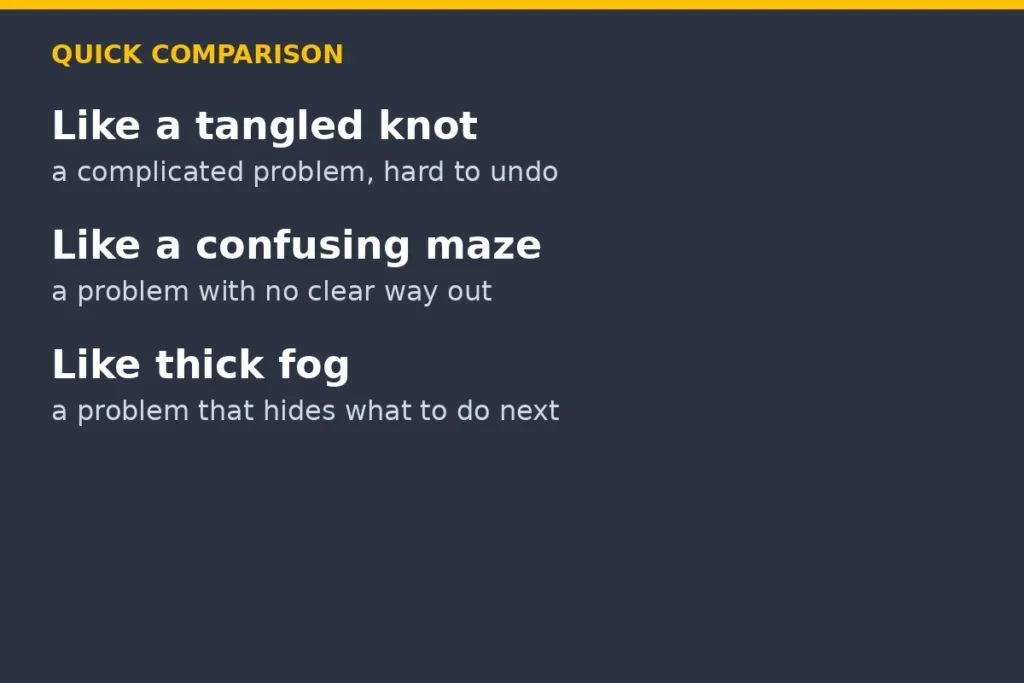
1. Like a Tangled Knot
Meaning: Complicated and hard to untangle, with many connected parts.
Example: The family argument felt like a tangled knot that nobody could undo.
2. Like a Confusing Maze
Meaning: Hard to find a way out; every path seems wrong.
Example: The new tax rules were like a confusing maze for small businesses.
3. Like a Difficult Puzzle
Meaning: Needs careful thinking and patience to solve.
Example: The detective said the case was like a difficult puzzle with a hundred pieces.
4. Like an Unsolved Riddle
Meaning: Mysterious and hard to understand.
Example: His sudden silence was like an unsolved riddle to his friends.
5. Like a Tangled Web
Meaning: Many problems connected to each other in a complex way.
Example: The lies formed a tangled web that trapped everyone involved.
6. Like Thick Fog
Meaning: A lack of clarity; you cannot see the way forward.
Example: Doubt spread through the team like thick fog before the final match.
7. Like a Cracked Mirror
Meaning: Gives a distorted, wrong view of the situation.
Example: After the accident, his memory of that day was like a cracked mirror.
8. Like a Jigsaw Puzzle With Missing Pieces
Meaning: Impossible to complete because key information is absent.
Example: Without the missing report, the investigation was like a jigsaw puzzle with missing pieces.
Similes for Sudden and Overwhelming Problems
9. Like a Sudden Storm
Meaning: Arrives without warning and feels overwhelming and intense.
Example: The bad news hit the family like a sudden storm.
10. Like an Earthquake
Meaning: A life-changing shock that shakes everything.
Example: Losing his job felt like an earthquake under his whole life.
11. Like Rolling Thunder
Meaning: A shocking impact whose effects keep rumbling on.
Example: The announcement struck the office like rolling thunder.
12. Like Crashing Waves
Meaning: Difficulties that return again and again without rest.
Example: During the crisis, stress came like crashing waves, one after another.
13. Like a Storm at Sea
Meaning: A dangerous challenge where survival itself feels uncertain.
Example: Leading the company that year was like a storm at sea.
14. Like an Avalanche
Meaning: Starts small, then buries you under its growing weight.
Example: A few unpaid bills grew into debt like an avalanche.
15. Like a Lightning Strike
Meaning: A sudden, shocking blow with no time to prepare.
Example: The diagnosis came like a lightning strike on a clear day.
16. Like a Dam Breaking
Meaning: Long-held pressure suddenly released all at once.
Example: When the truth came out, the scandal burst like a dam breaking.
17. Like a Sudden Sinkhole
Meaning: An unexpected collapse under something that seemed solid.
Example: When the emails leaked, trust in the manager fell like a sudden sinkhole.
Similes for Heavy and Trapping Problems
18. Like Heavy Chains
Meaning: Restricts your movement and freedom.
Example: His debt felt like heavy chains he dragged everywhere he went.
19. Like a Crushing Burden
Meaning: Emotional weight that presses down on the mind.
Example: Caring for everyone alone became a crushing burden for her.
20. Like Sinking Quicksand
Meaning: The more you struggle, the deeper you sink.
Example: The more he lied, the more it felt like sinking quicksand.
21. Like a Heavy Cage
Meaning: Makes you feel trapped, with no freedom to move.
Example: Her fear of failure felt like a heavy cage around her dreams.
22. Like a Dark Shadow
Meaning: A constant presence that never leaves you alone.
Example: Worry followed him like a dark shadow through the whole year.
23. Like an Anchor Dragging You Down
Meaning: Holds you back and pulls you below where you want to be.
Example: His old habits were like an anchor dragging him down.
24. Like a Long Dark Tunnel
Meaning: A hard period with no light or end in sight.
Example: The months of recovery felt like a long dark tunnel.
25. Like a Locked Door
Meaning: A blocked situation with no easy way through.
Example: Every office gave the same refusal, and the whole process felt like a locked door.
26. Like Heavy Mud
Meaning: Makes every step slow and exhausting.
Example: With the old computer, simple work dragged like heavy mud.
27. Like Loose Sand
Meaning: Unstable ground; nothing feels safe or certain.
Example: After the rumours, their trust felt like loose sand underfoot.
Similes for Growing and Spreading Problems
28. Like Fast-Growing Weeds
Meaning: Spreads quickly and takes over if ignored.
Example: Small errors in the accounts grew like fast-growing weeds.
29. Like a Spreading Wildfire
Meaning: Grows fast and becomes very hard to control.
Example: The rumour moved through the school like a spreading wildfire.
30. Like a Crack in Glass
Meaning: Starts small but quietly becomes dangerous.
Example: One small doubt spread through the friendship like a crack in glass.
31. Like a Leaking Roof
Meaning: Small but constant; it never stops bothering you.
Example: The stress at work was like a leaking roof — always dripping, never fixed.
32. Like Fire Under Ashes
Meaning: A hidden danger that is not visible yet.
Example: His anger burned quietly, like fire under ashes, all evening.
33. Like a Ticking Time Bomb
Meaning: Quiet now, but certain to explode if not handled.
Example: Everyone knew the unpaid loan was a ticking time bomb.
34. Like a Snowball Rolling Downhill
Meaning: Grows bigger and faster the longer it rolls.
Example: One missed payment became a snowball rolling downhill of fees and fines.
35. Like a Storm Cloud Overhead
Meaning: A warning sign that trouble is coming.
Example: The manager’s silence hung over the meeting like a storm cloud overhead.
36. Like Rust Eating Through Metal
Meaning: Slow, quiet damage that weakens things over time.
Example: Years of small lies worked like rust eating through metal in their marriage.
Similes for Blocking, Painful, and Broken Problems
37. Like a Dead-End Road
Meaning: Leads nowhere; there is no solution down this path.
Example: After weeks of talks, the negotiations reached a dead-end road.
38. Like Hitting a Wall
Meaning: Progress suddenly stops completely.
Example: Every time she applied for funding, she felt like hitting a wall.
39. Like a Sharp Thorn
Meaning: A small problem that causes constant pain.
Example: Regret stayed in his mind like a sharp thorn he could not pull out.
40. Like Thorns on a Path
Meaning: Makes every step of the journey painful.
Example: Their road to success was covered with thorns on the path.
41. Like a Sharp Blade
Meaning: Cuts deeply and hurts fast.
Example: Her cruel words cut through him like a sharp blade.
42. Like a Broken Bridge
Meaning: The connection is gone; there is no way across.
Example: After the argument, communication between the brothers was a broken bridge.
43. Like Walking on Ice
Meaning: Risky; one wrong step can cause a fall.
Example: Raising the topic with her boss felt like walking on ice.
44. Like a Steep Mountain
Meaning: A huge challenge that needs great effort to overcome.
Example: Paying off the loan felt like a steep mountain with no easy path.
45. Like a Broken Clock
Meaning: Not working at all; the system is useless.
Example: The old booking process was like a broken clock — right only by accident.
46. Like a Sinking Ship
Meaning: A failing situation that is going down fast.
Example: By spring, the whole project was a sinking ship, and the team knew it.
47. Like a Splinter Under the Skin
Meaning: Tiny but irritating; impossible to ignore.
Example: The unanswered question stayed like a splinter under the skin all week.
48. Like a Headache That Won’t Go Away
Meaning: A nagging problem that returns every day.
Example: The neighbour’s noise was like a headache that won’t go away.
49. Like a Flat Tire
Meaning: Stops your journey until it is fixed.
Example: The missing document was a flat tire in the middle of their plans.
50. Like a Storm in a Teacup
Meaning: A big fuss over something actually small.
Example: The argument about the seating plan was just a storm in a teacup.
All 50 Similes for Problems at a Glance
| # | Simile | Meaning |
|---|---|---|
| 1 | Like a tangled knot | Complicated and hard to untangle |
| 2 | Like a confusing maze | Hard to find a way out |
| 3 | Like a difficult puzzle | Needs careful thinking |
| 4 | Like an unsolved riddle | Mysterious and hard to understand |
| 5 | Like a tangled web | Many problems connected together |
| 6 | Like thick fog | No clarity about the way forward |
| 7 | Like a cracked mirror | Gives a distorted view |
| 8 | Like a jigsaw puzzle with missing pieces | Impossible to complete |
| 9 | Like a sudden storm | Overwhelming and without warning |
| 10 | Like an earthquake | A life-changing shock |
| 11 | Like rolling thunder | Shocking impact that keeps rumbling |
| 12 | Like crashing waves | Difficulties that keep returning |
| 13 | Like a storm at sea | Dangerous and uncertain |
| 14 | Like an avalanche | Buries you as it grows |
| 15 | Like a lightning strike | A sudden, shocking blow |
| 16 | Like a dam breaking | Pressure released all at once |
| 17 | Like a sudden sinkhole | An unexpected collapse |
| 18 | Like heavy chains | Restricts freedom |
| 19 | Like a crushing burden | Heavy emotional weight |
| 20 | Like sinking quicksand | Struggling makes it worse |
| 21 | Like a heavy cage | Makes you feel trapped |
| 22 | Like a dark shadow | A constant presence |
| 23 | Like an anchor dragging you down | Holds you back |
| 24 | Like a long dark tunnel | A hard period with no end in sight |
| 25 | Like a locked door | No easy way through |
| 26 | Like heavy mud | Makes every step slow |
| 27 | Like loose sand | Unstable and uncertain |
| 28 | Like fast-growing weeds | Spreads quickly if ignored |
| 29 | Like a spreading wildfire | Grows fast, hard to control |
| 30 | Like a crack in glass | Small but dangerous |
| 31 | Like a leaking roof | Small but constant |
| 32 | Like fire under ashes | A hidden danger |
| 33 | Like a ticking time bomb | Certain to explode if ignored |
| 34 | Like a snowball rolling downhill | Grows bigger and faster |
| 35 | Like a storm cloud overhead | A warning of coming trouble |
| 36 | Like rust eating through metal | Slow, quiet damage |
| 37 | Like a dead-end road | Leads nowhere |
| 38 | Like hitting a wall | Progress stops suddenly |
| 39 | Like a sharp thorn | Small but constantly painful |
| 40 | Like thorns on a path | Makes every step painful |
| 41 | Like a sharp blade | Cuts deeply and hurts |
| 42 | Like a broken bridge | No connection or way across |
| 43 | Like walking on ice | Risky; one step can cause a fall |
| 44 | Like a steep mountain | A huge challenge |
| 45 | Like a broken clock | Not working at all |
| 46 | Like a sinking ship | A failing situation |
| 47 | Like a splinter under the skin | Tiny but impossible to ignore |
| 48 | Like a headache that won’t go away | A nagging, daily problem |
| 49 | Like a flat tire | Stops the journey until fixed |
| 50 | Like a storm in a teacup | A big fuss over something small |
How to Write Your Own Similes for Problems
Create your own similes for problems in four steps:
- Name the feeling of the problem. Is it confusing, heavy, sudden, or growing? The feeling tells you which family of pictures to use.
- Pick a familiar thing with that feeling. A maze is confusing, chains are heavy, a storm is sudden, and weeds grow when ignored.
- Check the size matches. A small annoyance is a splinter or a leaking roof, not an earthquake. Keep the picture honest.
- Join them with “like” or “as.” Write it fully: “The paperwork was like a tangled knot.” Then read it aloud to check it sounds natural.
Tip: one strong simile per paragraph is usually enough. Too many pictures in one place fight with each other and confuse the reader.
Frequently Asked Questions
What is a simile for problems?
It is a comparison that explains a difficulty through something familiar, using “like” or “as.” Example: “The problem was like a tangled knot” suggests something complicated that is hard to undo.
What are the best similes for problems?
If you ask what is a good simile for problem writing, start with the favourites: “like a tangled knot” for complicated problems, “like a ticking time bomb” for problems about to explode, “like heavy chains” for problems that hold you back, and “like a steep mountain” for huge challenges. See the top 10 list above.
How do I write my own simile for problems?
Name the feeling of the problem first — confusing, heavy, sudden, or growing — then pick a familiar thing with the same feeling and join them with “like” or “as.” See the step-by-step section above.
What is the difference between a simile and a metaphor for problems?
A simile uses “like” or “as” — “Her worries were like heavy chains.” A metaphor drops those words and says the thing is something else — “Her worries were chains.”
How do I choose between a big problem simile and a small problem simile?
Match the picture to the size of the trouble. Use earthquakes, storms, and mountains for serious problems, and splinters, leaking roofs, and flat tires for small daily ones, so your writing stays believable.
Can I use these similes in my essay, story, or speech?
Yes. These are common descriptive phrases; you can use them freely in essays, stories, speeches, and everyday conversation. Pick the picture that matches your problem’s feeling and size.
Final Conclusion
You now have 50 similes for problems — more than the usual lists — sorted into confusing, sudden, heavy, growing, and broken problems, each with a meaning and an example. Use the table for quick revision, start with the top 10, then write your own with the four steps. For more simile lists, see our guide to similes for music.