Swap vs Swop: Which Spelling Is Correct?
Swap or swop — which spelling is correct? Here is the short truth: both words mean exactly the same thing, “to exchange or trade one thing for another,” but swap is the standard spelling used everywhere in the world today. Swop is an older British spelling of the same word. It is not a different word, and it is not really wrong — it is just old-fashioned and rare now.
In this guide, you will learn what swap and swop mean, where the spelling swop came from, how the two spellings are used in different countries, clear example sentences, common mistakes, and a simple trick so you always choose the right one. You will also learn the grammar of swap — because swap works as both a verb and a noun, and it follows patterns that every learner should know. If you have ever wondered “is it swap or swop?” or searched for the swap vs swop meaning, this guide gives the full answer.
The Short Answer: Use “Swap”
If you only remember one line from this page, remember this one:
- Swap = the standard, modern spelling. Use it in exams, emails, work documents, and everyday writing, in every country.
- Swop = the same word in an older British spelling. You may meet it in old British books, or at traditional British school events, but you almost never need to write it yourself.
The two words are also pronounced exactly the same way: /swɒp/ — one syllable, rhyming with “top” and “shop.” Only the spelling on the page is different.
What Does “Swap” Mean?
Swap means to give something and receive something else in return — an exchange where both sides trade. Children swap stickers, workers swap shifts, and traders swap currencies. The Cambridge Dictionary entry for swap defines it as giving something and getting something else in its place — and that one idea sits inside every use of the word.
Swap as a verb
As a verb, swap follows regular patterns. Its forms are: swap – swapped – swapping. Note the double “p” in swapped and swapping, because the word ends in a single vowel + p.
- Swap A for B: “I swapped my sandwich for her apple.”
- Swap with someone: “Can I swap seats with you?”
- Swap places / seats / shifts / jobs: “The two nurses swapped shifts on Friday.”
- Swap something over / round: “If we swap the chairs over, everyone can see the board.”
Swap as a noun
Swap is also a noun — the exchange itself, or an event where people exchange things:
- “It was a fair swap — my old bike for his guitar.”
- “The school is holding a book swap on Saturday.” (an event)
- “Let’s do a swap: you take my morning shift, and I take your evening one.”
Modern uses of swap
Swap is very alive in modern English, in technology and money as well as daily life:
- SIM swap / swap a SIM card: moving your number to a new card or phone.
- Swap out: replace one thing with another — “We swapped out the old printer for a faster one.”
- Swap meet / swap shop: a market or event where people exchange goods (swap shop is especially British).
- Currency swap / interest-rate swap: a formal agreement in finance to exchange payments.
- Body swap / role swap: popular in films and games, where two people exchange bodies or roles.
What Does “Swop” Mean?
Swop means exactly the same as swap — to exchange or trade. Dictionaries list it as a variant spelling of swap, mainly British. It has no different meaning, no different grammar, and no different pronunciation. If you replace swop with swap in any old sentence, the sentence means exactly the same thing.
Where might you still see swop today?
- In older British books and newspapers, where it was a normal spelling.
- At traditional British school “swop shops” — events where children exchange toys, books, or stickers. The old spelling survives in the name.
- In writing that wants a deliberately old-fashioned British flavour, such as historical stories.
Outside those corners, swop has almost disappeared. Modern British writers, newspapers, and exams overwhelmingly use swap.
Where Did “Swop” Come From? A Short History
The word swap is old. It comes from an old English word meaning “to strike” — because long ago, two people sealed a bargain by striking hands when they agreed to exchange goods. The slap of hands became the name of the exchange itself: a swap.
Swop appeared later, in British print of the 1800s and early 1900s, as an alternative spelling that matched the round “o” sound of the word. For a time, British books and newspapers used both spellings side by side. But during the 1900s, swap slowly won the contest — first in America, then in Britain too — and dictionaries settled on swap as the main entry, with swop kept as a noted variant. So swop is best understood as swap’s older spelling, not as a separate word.
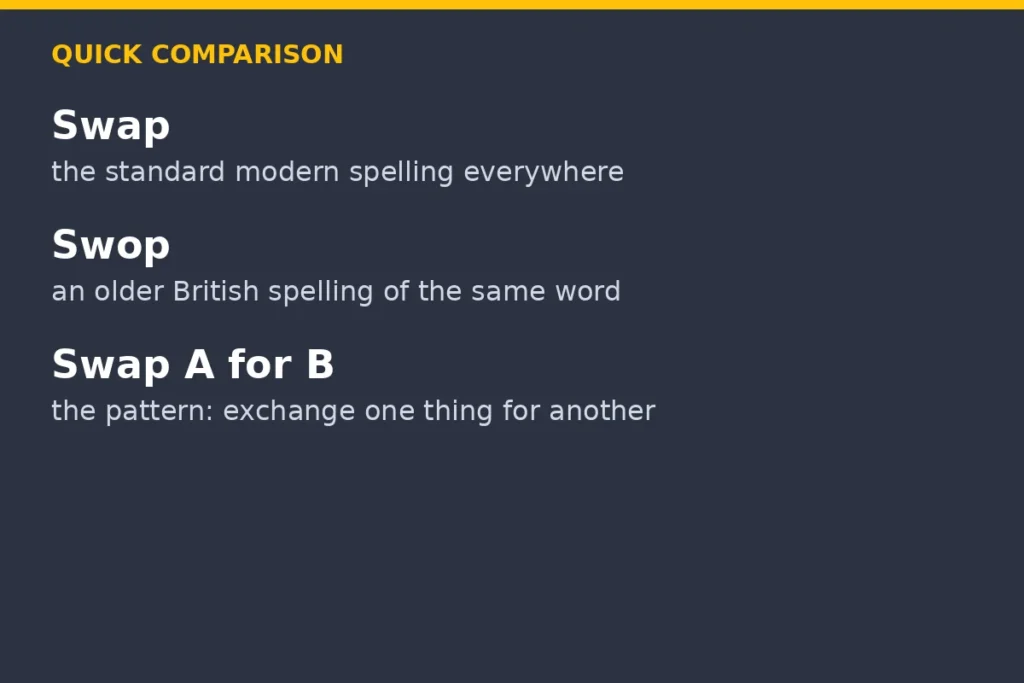
Quick Comparison: Swap vs Swop
| Point | Swap | Swop |
|---|---|---|
| Meaning | To exchange or trade | To exchange or trade (identical) |
| Pronunciation | /swɒp/ | /swɒp/ (exactly the same) |
| Status | Standard spelling everywhere | Older variant spelling, mainly British |
| Where used today | All English-speaking countries | Rare: old British texts, “swop shop” events |
| Formal writing and exams | Yes — always safe | No — choose swap instead |
| Verb forms | swap, swapped, swapping | swop, swopped, swopping (rare) |
| Example | Let’s swap seats. | Let’s swop seats. (old British style) |
Examples of “Swap” in Sentences
- I swapped my sandwich for a piece of cake.
- Can we swap seats? I want to sit near the window.
- The two nurses swapped shifts so that Anna could attend the wedding.
- Jake swapped his old bike for a guitar — both boys were happy with the swap.
- We swapped phone numbers before leaving the party.
- If the shoes are too small, the shop will swap them for a bigger size.
- The teacher asked the students to swap papers and mark each other’s work.
- He swapped out the broken wheel for a new one in ten minutes.
Examples of “Swop” in Sentences
You will meet sentences like these in older British writing. Read them, understand them — but write your own sentences with swap.
- The children swopped stickers in the playground. (old British spelling)
- At the village swop shop, neighbours exchanged books and toys.
- In the story, two farmers swop horses at the fair.
- “Let us swop places,” said the old man in the novel.
Swap and Swop in Different Contexts
At school
Children trade small things constantly, and English uses swap for all of it: swap stickers, swap cards, swap seats, swap books. British schools sometimes keep the traditional name “swop shop” for a trading event, but the everyday verb in the classroom is swap.
At work
Adults swap duties and time: swap shifts, swap tasks, swap roles for a day, swap offices. In work emails and schedules, only swap is used — swop would look like a typing error to most readers today.
Technology and phones
Modern technology fixed the spelling firmly as swap: SIM swap, swap a device, swap files between phones, hot-swap a battery. No phone menu or manual uses swop.
Money and business
In finance, swap is a technical noun: a currency swap, an interest-rate swap, a credit default swap. These are formal legal terms, always spelled with “a”.
British heritage writing
The one place swop still earns its keep is writing that deliberately sounds old and British — a historical novel, a museum display about a 1950s school, or the name of a traditional swop shop. There, swop is a flavour choice, not the normal rule.
Why People Confuse Swap and Swop
The confusion is natural, for three reasons. First, the words sound identical, so your ear cannot help you choose the spelling — the same trap as sound-alike pairs like sale vs sail. Second, older British books are still in libraries and school readers, so learners meet swop in print and wonder if it is a different word. Third, English has many word pairs where a spelling difference does change the meaning, so learners reasonably ask whether swap and swop differ too. They do not — this pair is only a spelling variant, which is exactly why it confuses people.
Common Mistakes to Avoid
- Using swop in American or international writing: ✗ “I will swop seats with him on the flight.” → ✔ “I will swap seats with him on the flight.” Outside old British contexts, swop looks like a mistake.
- Mixing both spellings in one document: ✗ “We swapped the cards, then swopped the books.” → ✔ “We swapped the cards, then swapped the books.” Pick one spelling — swap — and keep it everywhere.
- Forgetting the double p: ✗ “They are swaping places.” → ✔ “They are swapping places.” Swap doubles its final p before -ed and -ing.
- Thinking swop has a different meaning: ✗ “Swap means trade, but swop means exchange formally.” → ✔ Both words mean exactly the same; only the spelling and age differ.
- Using the wrong pattern: ✗ “I swapped my seat to his seat.” → ✔ “I swapped seats with him,” or “I swapped my seat for his.” Swap takes with (a person) and for (the thing received).
Spelling variants like this appear in many English word pairs — our guide to smoothe vs smooth explains another pair where one spelling is standard and the other survives only in special uses.
Tricks to Remember
- “A” is for Accepted: swap has the letter A — and it is the accepted spelling everywhere. When in doubt, choose the A.
- Swop belongs to history: the “o” in swop can remind you of old books and old British schools.
- One document, one spelling: never mix swap and swop in the same piece of writing.
- The reading rule: when you read swop in an old book, just read it as swap — same sound, same meaning.
Self-Check Quiz
- Which spelling should you use in an exam: swap or swop?
- True or false: Swop has a different meaning from swap.
- Write the -ing form: swap → ______.
- Complete the sentence: “Can I swap seats ______ you?” (with / to)
- In which country and period was swop a normal spelling?
Answers: 1. Swap — it is the standard spelling everywhere. 2. False — the meaning and pronunciation are identical. 3. Swapping (double the p). 4. With — swap takes “with” for a person, “for” for the thing you receive. 5. Britain, in older writing (1800s–early 1900s), where it survives today mainly in “swop shop”.
Frequently Asked Questions
What is the difference between swap and swop?
There is no difference in meaning or pronunciation. Swap is the standard modern spelling used worldwide; swop is an older British variant of the same word. The only difference is the spelling and how old-fashioned it looks.
Is swop wrong?
Not exactly — dictionaries accept swop as a variant spelling, so it is not an error in old British writing. But in modern writing, especially outside the UK, readers will usually treat swop as a typo. For your own writing, swap is always the safer choice.
Which spelling should I use in exams and formal writing?
Always use swap. It is the spelling in every major dictionary’s main entry, in school and exam marking, in business documents, and in technology terms like SIM swap. Swop has no advantage in any formal situation.
Are swap and swop pronounced differently?
No. Both are pronounced /swɒp/, rhyming with “top.” This is a spelling-only difference — in speech, nobody can tell which one you are thinking of.
Can swop be used as a noun, like swap?
Yes, in older British English swop worked as both a verb and a noun, just like swap: “a fair swop.” Today the noun is almost always written swap — “a fair swap,” “a book swap.”
Why do some British schools still say “swop shop”?
Because the name is traditional. School swop shops — where children exchange toys and books — kept the old spelling as part of their name, the way some old shop signs keep old spellings. It is a name, not a rule: the children still swap their toys.
Final Conclusion
Swap vs swop is one of the easiest choices in English spelling: the two words mean the same thing and sound the same, but only one of them belongs in modern writing. Write swap — for trading cards, swapping shifts, SIM swaps, and fair swaps of every kind. Read swop calmly when you meet it in an old British book or a traditional swop shop sign, and understand it as the same word in older clothes. Choose swap, keep it consistent, and this pair will never trouble you again.