
Mother Tongue vs Native Language: What Is the Difference?
Mother tongue and native language — are they the same thing? For many people, yes. But for millions of others, they are two different languages. Your mother tongue is the first language you learned at home as a small child, from your parents and family. Your native language is the language you know best and use most naturally in daily life — at school, at work, and in society. Often they are one and the same language, but migration, multilingual homes, and education can pull them apart.
In this guide, you will learn the exact meaning of both terms, how they differ, how they can be the same, real-life examples, why the difference matters, common mistakes, and simple tricks to remember which is which. Put simply, the mother tongue vs native language difference is about where a language starts in your life versus how completely it becomes yours.
The Short Answer
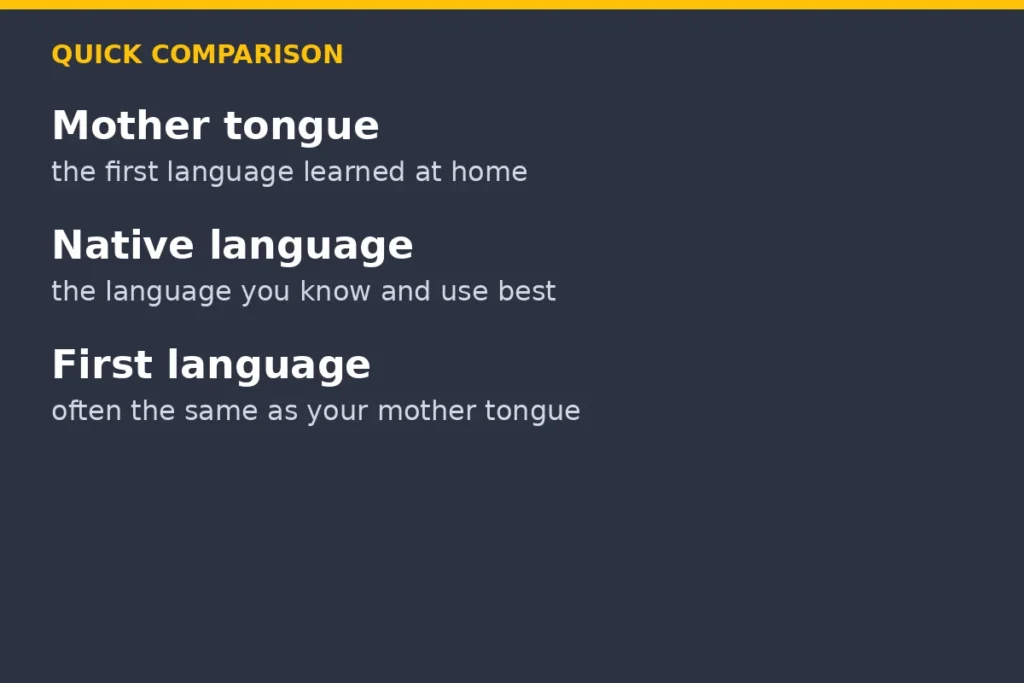
- Mother tongue = the first language you learned at home, from your family. It is about origin — where your language story begins.
- Native language = the language you speak most fluently in everyday life. It is about mastery — the language that works best for you now.
A child who grows up speaking Punjabi with her parents but studies, works, and socializes in English may have Punjabi as her mother tongue and English as her native language. A child raised in a French-speaking home in France usually has French as both.
What Is a Mother Tongue?
Your mother tongue is the very first language you heard and learned as a baby and small child, inside your home. The name comes from the idea of the language learned “at your mother’s side” — from the people who raised you. The Cambridge Dictionary definition of “mother tongue” says the same: it is “the first language that you learn when you are a baby.”
Key points about a mother tongue:
- It is learned before school, naturally, without lessons or books.
- It is deeply connected to family, emotions, and culture — the language of home, jokes, and childhood memories.
- It normally never changes. Even if you stop using it for years, it stays your mother tongue because it was your first.
- You can have more than one if your home used two languages from the start — for example, Urdu with your mother and Punjabi with your father.
Examples: a baby in Tokyo hears Japanese from her parents, so Japanese is her mother tongue. A child in Lahore hears Punjabi at home, so Punjabi is his mother tongue — even if he later studies in English.
What Is a Native Language?
Your native language is the language you command most fully — the one you think in, speak without effort, and use for education, work, and public life. Someone with native-level ability understands jokes, idioms, and small differences in meaning.
Key points about a native language:
- It is measured by fluency and daily use, not by birth or family.
- It is shaped by your environment — school, friends, work, and the country you live in.
- It can change over time. If you move to another country and live there for many years, a new language can become your strongest one.
- Accent does not decide it. Fluency and natural, comfortable use do.
Example: the child from Lahore grows up, studies medicine in English, and works in a hospital in London, thinking and dreaming in English. English has become his native language in daily life — while Punjabi remains his mother tongue.
Two Related Terms: “First Language” and “Dominant Language”
Two more expressions often appear in this topic:
- First language (L1) — almost the same as mother tongue: the first language a child learns. Schools and linguists often prefer this neutral term.
- Dominant language — the language a person is strongest in at a given time. It often matches the native language, and it can shift during a lifetime.
So the three ideas work together: your mother tongue is where you started, and your native language is what you use best now.
Quick Comparison: Mother Tongue vs Native Language
| Point | Mother Tongue | Native Language |
|---|---|---|
| Basic meaning | The first language learned in childhood at home | The language used most fluently in daily life |
| Where it is learned | At home, before school age | At home, at school, and in society |
| Learned from | Parents and family | Family, teachers, friends, and the whole environment |
| Main idea | Origin and identity | Fluency and function |
| Emotional link | Very strong — tied to childhood and culture | Strong, but more practical than emotional |
| Can it change? | No — your first language stays your mother tongue | Yes — migration or a new environment can shift it |
| Example | Hindi learned from parents at home in Delhi | English used at university and work in Toronto |
Example Sentences
Sentences with “Mother Tongue”
- Her mother tongue is Bengali, but she writes her reports in English.
- Children learn new subjects faster when teachers teach in their mother tongue.
- He speaks three languages, but his mother tongue is Arabic.
- The poem sounds most beautiful in the poet’s mother tongue.
Sentences with “Native Language”
- English is not his native language, but he speaks it fluently.
- The job requires a person whose native language is Spanish.
- She translated the letter into her native language, French.
- The software now works in twenty native languages, including Urdu and Hindi.
Real-Life Situations: When the Two Are Different
Children of Immigrant Families
A family moves from Mexico to the United States. At home, everyone speaks Spanish, so Spanish is the children’s mother tongue. At school and with friends, the children use English all day, and by their teenage years English is the language they handle best. Both answers are true at the same time, because the two terms answer two different questions.
Multilingual Countries
In countries like India, Pakistan, Canada, and Nigeria, many children grow up with a regional mother tongue — Punjabi, Pashto, or Yoruba — and an official language, such as English or French, at school and in government offices. Their mother tongue carries their identity; the public language carries their education and career.
Adopted Children and Language Shift
A child born in Korea but adopted as a baby by a family in Sweden grows up hearing only Swedish. In practice, Swedish becomes both her first home language and her native language. Adoption shows how strongly the home environment shapes both terms.
International Schooling
Some children attend international schools from a very young age, in a language their parents do not speak. A Japanese child in a full-time English school in Bangkok may end up stronger in English than in Japanese: her mother tongue is Japanese, but her most native-like language may be English.
When Mother Tongue and Native Language Are the Same
For most people, the story is simpler: the first language they learned at home is also the language of their school, their town, and their job. A child raised in a Spanish-speaking home in Spain, educated and working in Spanish, has one language as mother tongue, first language, and native language together. The two terms only separate when life moves a person between languages.
Why the Difference Matters
Education and Learning
Research and everyday experience agree: young children understand new ideas best in their mother tongue. Good schools build on the home language first and add other languages step by step. If teachers ignore the mother tongue, children may struggle in every subject.
Identity and Culture
A mother tongue carries family history, traditions, humour, and feelings. Grandparents’ stories, folk songs, and prayers usually live in the mother tongue. Keeping it alive keeps a person’s roots alive — even when another language runs their working day.
Jobs, Forms, and Official Questions
Employers, universities, and governments often ask about your mother tongue and your native language separately. They are testing two different things: background and identity on one side, and real working fluency on the other. Answer carefully and honestly.
Census and Policy
Governments count mother tongues to plan schools, media, and public services for each community, and to protect minority languages.
How to Identify Your Mother Tongue and Native Language
Find your mother tongue
Ask: “What language did I hear and speak first, at home, as a small child?” That language is your mother tongue — whatever happened later in your life.
Find your native language
Ask: “In which language do I think and speak most easily today, without translating in my head?” That is your native language in practice.
Writing them on a form or resume
List them separately and honestly — for example: “Mother tongue: Urdu. Native-level fluency: English.” Clear entries show employers exactly what you can do.
Keeping both strong
Read, watch films, and talk with family in your mother tongue; study and work actively in your native language. Regular use keeps both alive — a real advantage in a connected world.
Why People Confuse These Terms
- They overlap for most people. When both terms describe the same language, the difference between them stays invisible.
- The names sound similar in spirit. Both contain the idea of “natural” or “from birth,” so people use them as simple synonyms — a little like the word pairs people mix up in our guide to neither vs either, where two related forms are easy to swap.
- Loose everyday usage. In casual speech, “native language” is often used for any first language, and dictionaries list the two as near-synonyms, so the careful distinction is rarely taught.
Common Mistakes to Avoid
- ✗ “My mother tongue is English because I learned it at school for ten years.” → ✔ A school language is not a mother tongue; your mother tongue is the first language you learned at home.
- ✗ “His native language must be Italian — listen to his accent.” → ✔ Accent does not decide a native language; fluency and natural daily use do.
- ✗ Filling a form with different answers by accident — writing your mother tongue in the “native language” box when the form wants your strongest working language. → ✔ Read each question: origin questions want the mother tongue; fluency questions want the native language.
- ✗ “She has no mother tongue because her family moved when she was five.” → ✔ Everyone who learned a first language at home has a mother tongue; moving house does not erase it.
- ✗ “You can only have one mother tongue.” → ✔ Children in bilingual homes can have two mother tongues from the very beginning.
Tricks to Remember
- Mother = beginning. Your mother tongue is the language of your beginning — the first words you ever learned, at home.
- Native = natural now. Your native language is the one that feels most natural to you today. “Native” answers “What do I speak best now?” — “mother tongue” answers “What did I speak first?”
- Two questions test: Ask “Where did my language start?” (mother tongue) and “Where is my language strongest?” (native language). If both answers match, the terms overlap for you; if not, you have met the difference.
- Think of a tree. The mother tongue is the roots — first and permanent. The native language is the tallest branch — the part that grows strongest in the light of school and society.
Self-Check Quiz
Choose the best answer for each question, then check the answers below.
- Ayesha learned Sindhi from her parents at home in Karachi. She studied in English, works in English, and thinks in English. What is her mother tongue? (Sindhi / English)
- In the same story, which language is Ayesha’s native language in daily life? (Sindhi / English)
- True or false: A person can have two mother tongues.
- True or false: Your native language can change if you move to another country for many years.
- Which term is about origin — the first language learned at home? (mother tongue / native language)
- A form asks for the language you use most fluently at work. Which term fits this question? (mother tongue / native language)
Answers: 1. Sindhi (first learned at home) 2. English (used most fluently every day) 3. True (bilingual homes) 4. True (environment can shift it) 5. Mother tongue 6. Native language.
Frequently Asked Questions
What is the main difference between mother tongue and native language?
The mother tongue is the first language you learned at home as a child — it is about origin. The native language is the language you use most fluently in daily life — it is about mastery. They are often the same, but they do not have to be.
Can mother tongue and native language be the same?
Yes, and for most people they are. If you grew up, studied, and work in the language your parents spoke at home, that one language is both your mother tongue and your native language.
Can you have more than one mother tongue?
Yes. Children who grow up hearing two languages at home from the very start — for example, Spanish from their mother and Catalan from their father — can honestly have two mother tongues.
Can your native language change over time?
Yes. If you move to a new country and live, study, and work in a new language for many years, that language can become your strongest and most natural one. Your mother tongue, however, never changes, because it is fixed by your childhood.
Why do official forms ask for both mother tongue and native language?
Because the two answers give different information. The mother tongue shows cultural background and identity; the native language shows real communication ability. Governments use the first for planning and statistics; employers use the second to judge working fluency.
Does accent decide your native language?
No. Accent is only pronunciation. Fluency and habitual use — not accent — decide the native language.
Final Conclusion
Mother tongue vs native language is the difference between where your language started and where your language is strongest. Your mother tongue is the first language of your childhood home — permanent, emotional, and tied to your identity. Your native language is the language you live in now — fluent, practical, and shaped by school, work, and society. For many people the two are one language; for multilingual people they are two, and both are worth keeping strong. When someone asks, answer the two questions separately: what did you speak first, and what do you speak best?