Than vs Then: Meaning, Difference, and Correct Usage
Than vs then is one of the most common mix-ups in English writing. The two words look almost the same and sound almost the same, but they do completely different jobs. Than is used for comparisons: “She is taller than me.” Then is used for time and order: “We ate dinner, then we watched a film.” They are never interchangeable.
In this guide, you will learn when to use than vs then, the than vs then meaning in simple words, the fixed patterns each word belongs to, lots of example sentences, common mistakes, and an easy trick to remember which one to choose. People also type this question as then vs than, or ask when to use then vs than — it is the same question, and the rule below answers all of them.
Than vs Then: The Short Answer
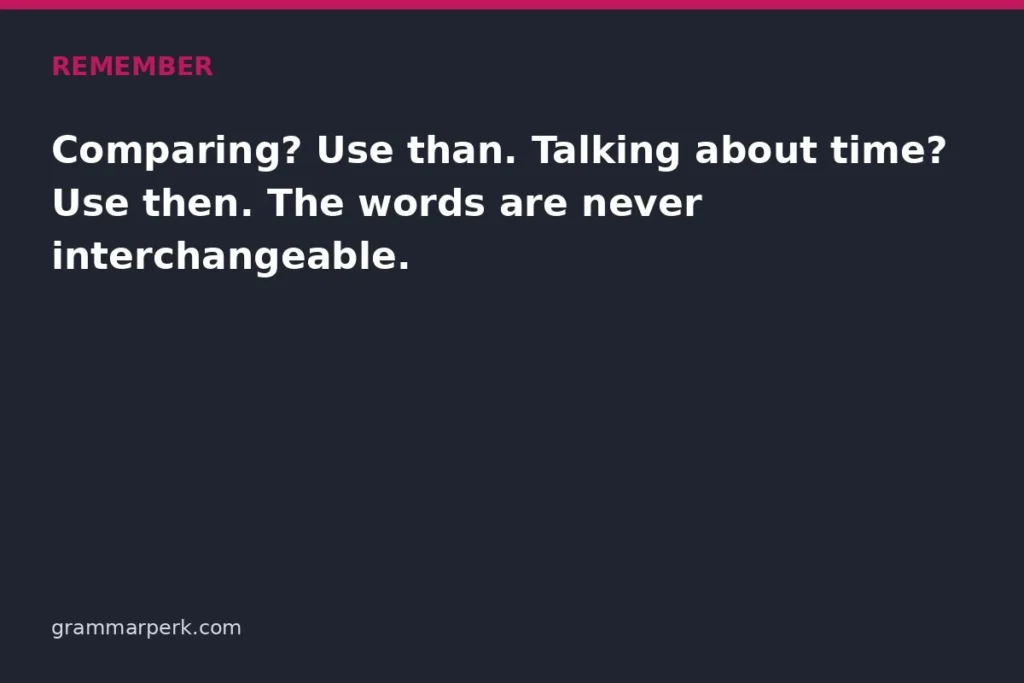
Ask yourself one question: Am I comparing two things? If yes, use than. If you are talking about when something happens, or what happens next, use then.
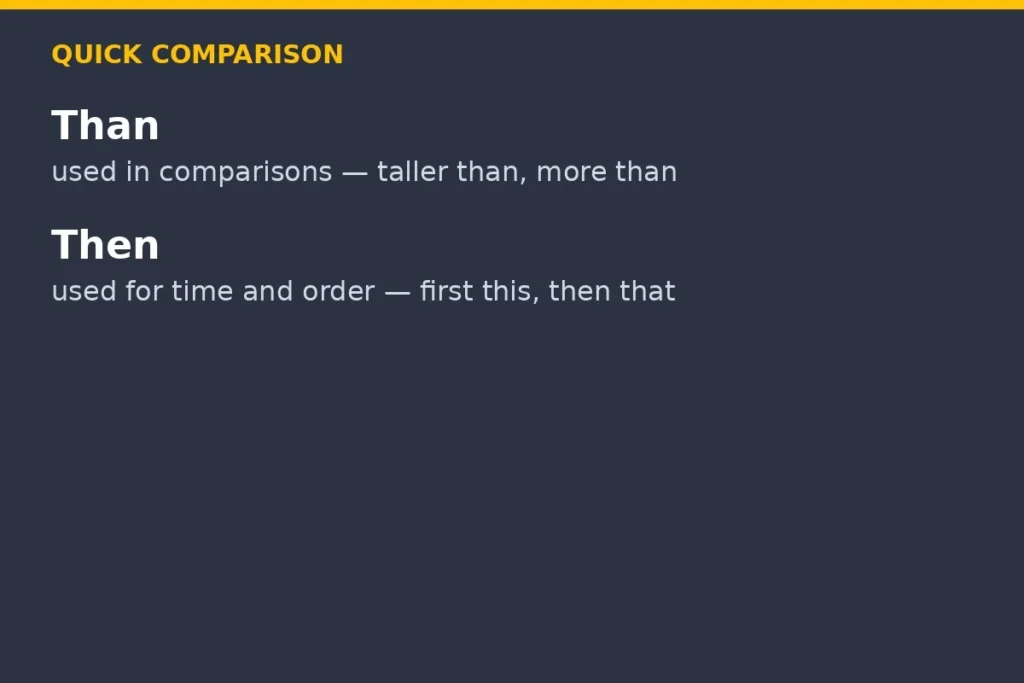
- Than = comparison. “This bag is heavier than that one.”
- Then = time or sequence. “First we practised, then we played the match.”
That one question solves almost every than/then problem. The rest of this guide gives you the patterns and practice to make it automatic.
When to Use “Than”
Than is a conjunction used in comparisons. It almost always appears right after a comparative word — words like bigger, better, more, less, rather, or other. If you see a comparison anywhere in the sentence, “than” is the word you need.
Learn these common patterns:
- Comparative adjective + than: taller than, faster than, more difficult than, less expensive than.
- More / less + than: “We need more time than we thought.” “She earns less than her brother.”
- Rather than (preference or choice): “I would rather walk than wait for the bus.”
- Other than (except): “No one other than Sara knew the answer.”
- No sooner … than (as soon as): “No sooner had we sat down than the phone rang.”
As the Merriam-Webster entry for than shows, the word exists to introduce the second part of a comparison. No comparison, no “than.”
When to Use “Then”
Then is an adverb connected with time. It has four main uses:
- At that time (the past or future): “Back then, nobody had mobile phones.” “By then, we will be home.”
- Next in a sequence: “Wash the rice, then add water.” “He finished school, then found a job.”
- As a result (if … then): “If it rains, then we will stay home.” “If you are ready, then let us start.”
- In phrases: until then (“See you at five; until then, I will wait here”), now and then (sometimes), and and then (“We laughed, and then we cried”).
If the word answers the question “when?” or “what next?”, it is “then.”
Quick Comparison: Than vs Then
| Point | Than | Then |
|---|---|---|
| Job | Compares two things | Shows time or order |
| Word type | Conjunction | Adverb |
| Clue words near it | more, less, better, bigger, rather, other | first, next, back, by, until, if |
| Answers | “Compared to what?” | “When? What next?” |
| Example | Gold is heavier than silver. | We trained, then we rested. |
Examples of “Than” in Sentences
- Her new phone is faster than the old one.
- I would rather stay home than go out in this storm.
- The exam was easier than I expected.
- He has more experience than all the other workers.
- No one other than the manager has the key.
- This route is shorter than the main road.
- She arrived earlier than everyone else.
- No sooner had the match ended than the crowd started cheering.
Examples of “Then” in Sentences
- Finish your homework, then you can play outside.
- Back then, this whole area was farmland.
- If you press this button, then the machine starts.
- We will be on holiday until Friday; until then, the office is closed.
- First mix the flour and sugar, then add the eggs.
- He smiled, and then he told us the good news.
- Now and then, an old friend calls me out of the blue.
- By then, the train had already left.
One sentence can even contain both words: “If the new laptop is cheaper than the old one, then buy it.” The comparison takes “than”; the result takes “then.”
Than and Then in Different Contexts
Comparing Size, Price, and Ability
Any time you compare size, price, speed, or skill, use “than”: “This shirt costs more than that one.” “She swims faster than her sister.” Look for the comparative word (-er or more/less) — “than” follows it.
Telling a Story or Giving Instructions
Stories and instructions move step by step, so they use “then”: “He opened the letter. Then his face went pale.” Recipes do the same: “Boil the water, then add the pasta.”
Conditions and Results
In “if … then” sentences, “then” introduces the result: “If you study hard, then you will pass.” There is no comparison here, so “than” would be wrong.
Talking About the Past
“Back then” and “then” for past times are extremely common: “I lived in London then.” Time words cause other mix-ups too — our guide to annual vs yearly vs every year sorts out another set.
Why People Confuse Than and Then
In fast, natural speech, “than” and “then” often sound nearly identical — both can shrink to a weak /ðən/ sound. Because we write what we hear, the wrong spelling slips in, especially when typing quickly. The two words also look alike on the page: only one vowel changes (a/e). The difference is never sound or spelling — it is the job the word does in the sentence. Check the job, and the spelling follows.
Common Mistakes to Avoid
- Using “then” in a comparison: ✗ “Better then you” → ✔ “Better than you.”
- Using “than” for sequence: ✗ “We ate, than we slept.” → ✔ “We ate, then we slept.”
- Writing “more then”: ✗ “More then fifty people came.” → ✔ “More than fifty people came.”
- Using “than” after “if”: ✗ “If he calls, than tell me.” → ✔ “If he calls, then tell me.”
- Mixing them in one sentence: ✗ “She is older then me, than she acts.” → ✔ “She is older than me, then why does she act so young?” — every comparison takes “than,” every time step takes “then.”
Tricks to Remember
- The letter trick: Comparison has an “a” — and so does than. Time and when have an “e” — and so does then.
- The “compared to” test: If you can replace the word with the idea “compared to,” choose than.
- The “at that time” test: If you can replace the word with “at that time” or “next,” choose then.
- Spot the partner: A comparative word (bigger, more, less, rather, other) is “than” knocking at the door. An “if” earlier in the sentence usually means “then” is coming.
Self-Check Quiz
- She speaks French better ______ (than / then) her classmates.
- We had lunch, ______ (than / then) we went for a walk.
- If the shop is closed, ______ (than / then) we will go tomorrow.
- This jacket is warmer ______ (than / then) my old one.
- Back ______ (than / then), letters took weeks to arrive.
- I would rather cook ______ (than / then) order food; ______ (than / then) we save money too.
Answers: 1. than (comparison: better) 2. then (sequence: what happened next) 3. then (result after “if”) 4. than (comparison: warmer) 5. then (past time: back then) 6. than, then (preference first, then the result).
Frequently Asked Questions
What is the main difference between than and then?
Than is used only for comparisons: “taller than,” “more than,” “rather than.” Then is used for time and order: “back then,” “first… then,” “if… then.” Check the job of the word in the sentence and you will always choose correctly.
Can than and then appear in the same sentence?
Yes, and it happens often: “If this train is faster than the bus, then we should take the train.” The comparison (“faster than the bus”) takes “than,” and the result (“then we should…”) takes “then.” Each word keeps its own job.
Why do people confuse than and then so often?
Because in quick speech they sound almost the same, and on the page they differ by only one letter. Most mistakes happen while typing fast. Slowing down for one second and asking “comparison or time?” fixes nearly all of them.
Is it “better than” or “better then”?
It is always “better than.” “Better” is a comparative word, and comparisons always take “than”: “This version is better than the first one.” “Better then” is never correct in modern English.
How can I quickly remember the difference?
Use the letter trick: compArison → thAn (both have “a”); timE and whEn → thEn (both have “e”). Or ask the one big question: “Am I comparing?” Yes means “than”; anything about time or order means “then.”
Is one of them more formal than the other?
No. Both words are normal in formal and informal English. Formal reports, exams, friendly messages, and everyday speech all use “than” for comparisons and “then” for time. The choice depends on meaning, not on style.
Final Conclusion
Than compares; then tells time. If a sentence sets two things side by side — bigger, more, rather, other — it needs than. If it moves through time or steps — first, next, back then, if … then — it needs then. Learn the partner patterns, use the letter trick, and this famous mix-up will never trouble your writing again.
Keep building your skills with our guide to neither vs either and more confusing word pairs.