To Fast or Too Fast: Which One Is Correct?
To fast or too fast — which one should you write? The two phrases sound exactly the same, but they mean completely different things. To fast means to stop eating for a period of time. Too fast means moving or happening more quickly than is safe, comfortable, or correct. If your sentence is about food, choose to fast. If it is about speed, choose too fast.
In this guide, you will learn what to, too, and fast really mean, when each phrase is correct, lots of example sentences, the most common mistakes, simple tricks to remember the difference, and a short quiz to test yourself. Whether you came here to learn how to fast for health or religion, or because a car going too fast for you feels dangerous, this guide keeps the two meanings cleanly separate.
The Short Answer
- To fast = to not eat (a verb phrase). “She decided to fast for one day.”
- Too fast = more quickly than is good (an adverb phrase). “He drives too fast.”
One quick test: if you can replace the phrase with “very fast” and the sentence still works, you need too fast. If the sentence is about skipping meals, you need to fast. Everything below explains this in detail.
“To” and “Too”: The Real Difference
The whole problem comes from two little words: to and too. They are homophones — words that sound the same but have different spellings and meanings.
- To shows direction, purpose, or the start of a verb: “I went to school.” “I want to learn.”
- Too shows that something is more than enough, or it means “also”: “It is too hot.” “I am coming too.”
Here is the spelling cue almost every teacher uses: too has an extra “o” for its extra meaning. When something is extra — extra speed, extra heat, extra noise — the word with the extra letter is usually the right one.
What “To” Means
The word to does two main jobs in English, and both jobs appear in the phrase “to fast.”
“To” as a Preposition
As a preposition, to comes before a noun or pronoun and shows direction, a goal, or a receiver.
- “She walked to the market.” (direction)
- “Give it to me.” (the person who receives something)
- “We listened to the teacher.” (the person receiving the action)
“To” as an Infinitive Marker
Before a verb, to forms the infinitive: to + base verb. This is the structure inside “to fast”: to + the verb fast.
- “He plans to fast tomorrow.”
- “They want to eat early.”
- “She hopes to pass the exam.”
So whenever to stands before a verb, ask what the verb means. Here the verb is fast — and that changes everything, as the next sections show.
What “Too” Means
Too is an adverb with two common meanings:
- More than is wanted or safe: “The soup is too salty.” “You are speaking too fast.”
- Also: “I love you too.” “She is coming too.”
In “too fast,” the first meaning is at work: the speed is more than it should be. Notice that too often carries a small warning — something has gone past the right level, and a problem may follow. The Cambridge Dictionary entry for “too” gives this core meaning as “more than is needed or wanted.” Keep that idea of “more than” in mind: it is the key to the whole pair.
What “Fast” Means: Three Different Jobs
The confusion grows because fast itself has three jobs in English:
- Adjective (describes a noun): “a fast car,” “a fast runner.”
- Adverb (describes a verb): “She drives fast.” “Time passed fast.”
- Verb (an action): “They fast during Ramadan.” Here fast means to stop eating for a time.
In “to fast,” fast is the verb — the action of not eating. In “too fast,” fast is the adverb — it describes how an action is done, and too says the level is excessive. Same word, different job, different phrase.
When “To Fast” Is Correct
Use to fast when someone chooses not to eat (and sometimes not to drink) for a period of time. People fast for religious reasons, for health routines, or because a doctor asks them to before a medical test or operation.
- “Many Muslims choose to fast during Ramadan.”
- “The doctor told him to fast for twelve hours before the blood test.”
- “She has decided to fast on Mondays.”
Notice that “to fast” always answers the question “to do what?” — it names an action a person plans or chooses, never a speed.
When “Too Fast” Is Correct
Use too fast when a speed is higher than it should be — higher than is safe, comfortable, correct, or useful.
- “Slow down! You are driving too fast.”
- “The teacher speaks too fast for beginners.”
- “He finished the test too fast and made careless mistakes.”
A useful check: sentences with “too fast” usually suggest a bad result — danger, mistakes, confusion, or discomfort. If a problem result makes sense in your sentence, “too fast” is probably correct.
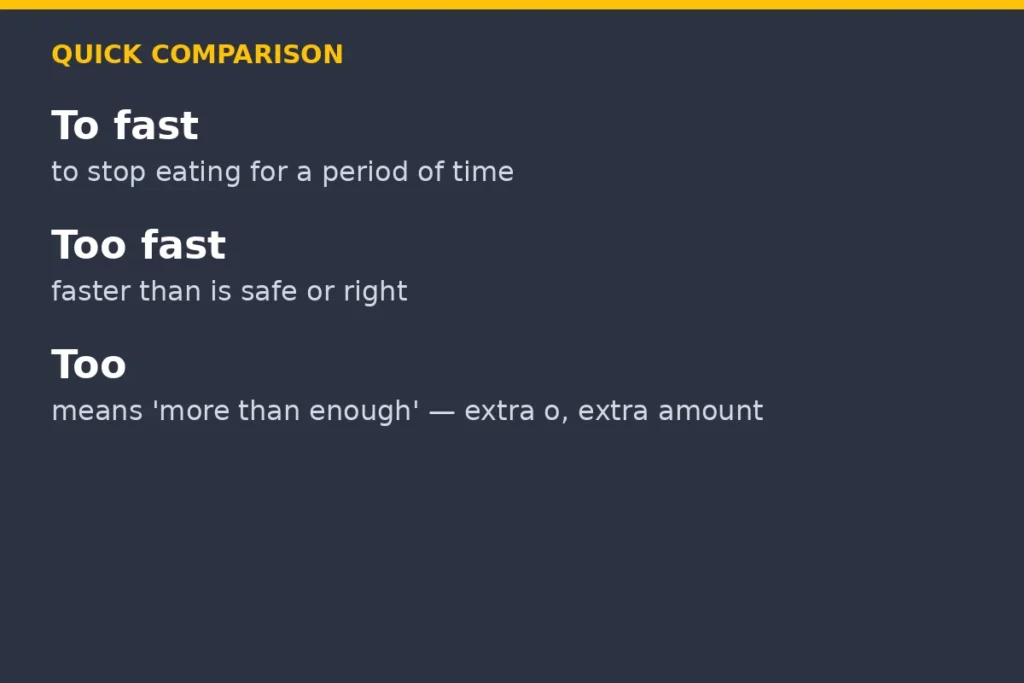
Quick Comparison: To Fast vs Too Fast
| Point | To Fast | Too Fast |
|---|---|---|
| Type | Verb phrase (to + verb) | Adverb phrase (too + adverb) |
| Meaning | To stop eating for a period of time | More quickly than is safe or right |
| Job of “fast” | A verb — an action you choose | An adverb — describes how something moves |
| Key word | to = infinitive marker before a verb | too = more than needed |
| Quick test | Can you say “to not eat”? Then use “to fast” | Can you say “very fast” or “excessively fast”? Then use “too fast” |
| Example | She chose to fast before the ceremony. | You are walking too fast for me. |
Examples of “To Fast” in Sentences
- He plans to fast for sixteen hours every day this month.
- Doctors may advise patients to fast before surgery.
- She agreed to fast during the retreat.
- They chose to fast and pray on the holy day.
- It is not safe for young children to fast for long periods.
- My grandfather used to fast twice a week.
Examples of “Too Fast” in Sentences
- The car was going too fast around the corner.
- You are typing too fast — that is why there are so many spelling mistakes.
- The movie moved too fast for me to follow the story.
- Children grow up too fast, parents often say.
- He ate too fast and got a stomach ache.
- The band played the song too fast, and the singer could not keep up.
“To Fast” in Different Contexts
Religion and Culture
Fasting is an old practice in many religions. Muslims fast from sunrise to sunset during Ramadan. Many Christians fast during Lent, and Jewish people fast on Yom Kippur. In these sentences, “to fast” is the natural and only correct choice: “They prepare to fast for the holy month.”
Health and Medical Reasons
Doctors often ask patients to fast before blood tests, scans, or operations, because food can change the results or make the operation unsafe. Health routines such as intermittent fasting also use the phrase: a person may decide to fast for sixteen hours and eat only during an eight-hour window each day.
Personal Discipline and Protests
Some people fast as a personal challenge or a form of discipline. A few even fast as a peaceful protest — the famous “hunger strike.” In every case, the idea is the same: a person chooses not to eat, so the phrase is to fast.
“Too Fast” in Different Contexts
Driving and Safety
This is the most common home of “too fast.” Police stop drivers who go too fast, road signs warn against speed, and fines punish it: “He was fined for driving too fast in a school zone.”
Learning and Speaking
Teachers and students use the phrase often. A teacher who speaks too fast confuses the class, and a student who reads too fast misses important details: “You learned the first chapter too fast and forgot the basics.”
Sports and Training
Athletes must control their speed. A runner who starts too fast may have no energy left at the finish, and training that increases too fast can cause injury or burnout: “The coach told her she had started the race too fast.”
Life and Relationships
People also use “too fast” for the speed of life itself: falling in love too fast, growing up too fast, or a year passing too fast. The meaning is still “more quickly than feels right.”
When Both Appear in One Sentence
Sometimes both phrases appear in the same sentence, and only their position and meaning separate them:
- “He tried to fast, but he gave up and ate — the day was passing too fast for him.” (Here to fast = not eat; too fast = time moving quickly.)
- “She hurried home too fast because she wanted to fast with her family at sunset.”
Read each part by its meaning, not by its sound, and the sentence becomes clear.
Why People Confuse “To Fast” and “Too Fast”
The reasons are simple and human:
- They sound identical. To and too are homophones, like the pair in our guide to sale vs sail — your ear cannot tell them apart.
- “Fast” has two lives. Most learners meet fast first as “quick,” so the “not eating” verb meaning surprises them.
- Fast typing. When we write quickly, the brain picks the spelling it uses most often — and that is usually “to.”
- The warning word is silent in speech. In “too fast,” the idea of “too much” is clear in writing but easy to miss when listening.
Common Mistakes to Avoid
- ✗ “I will too fast today.” → ✔ “I will to fast today.” — Not eating is a verb action, so it needs the infinitive to.
- ✗ “He drives to fast.” → ✔ “He drives too fast.” — Excess speed needs too, the “more than” word.
- ✗ “She speaks to fast for me.” → ✔ “She speaks too fast for me.”
- ✗ “The doctor asked me too fast before the test.” → ✔ “The doctor asked me to fast before the test.”
- ✗ “Don’t grow up to fast!” → ✔ “Don’t grow up too fast!”
- ✗ “They decided too fast during Ramadan.” → ✔ “They decided to fast during Ramadan.”
Tricks to Remember
- The extra “o” trick: Too has an extra “o” because it means something extra — extra speed, extra amount. Extra letter, extra meaning.
- The “very” test: Replace the phrase with “very fast.” If the sentence still makes sense (“He talks very fast” ✔), write too fast. If it breaks (“I want to very fast before the test” ✗), write to fast.
- The eating test: Ask, “Is this sentence about eating — or not eating?” If yes, the answer is to fast. If it is about speed, the answer is too fast.
- The verb test: If the word before fast must introduce an action after words like want, plan, decide, need, or choose (“She decided ___ fast”), it is the infinitive — to fast.
Self-Check Quiz
Choose the correct phrase for each sentence, then check the answers below.
- I need ___ fast before my surgery tomorrow. (to / too)
- You are typing ___ fast, so slow down and check your work. (to / too)
- They chose ___ fast for twenty-four hours. (to / too)
- The train went ___ fast through the small station. (to / too)
- She wants ___ fast during the holy month. (to / too)
- He read the instructions ___ fast and missed step three. (to / too)
Answers: 1. to (not eating before an operation) 2. too (excess speed) 3. to (chose not to eat) 4. too (speed) 5. to (not eating) 6. too (excess speed caused a mistake).
Frequently Asked Questions
When should I use “to fast” and when should I use “too fast”?
Use “to fast” when you mean not eating: “She decided to fast.” Use “too fast” when something moves or happens with excessive speed: “He drives too fast.” If “very fast” fits the sentence, choose “too fast”; if the sentence is about skipping food, choose “to fast.”
What does “fast” mean as a verb?
As a verb, “fast” means to stop eating (and sometimes drinking) for a period of time, usually for religious, health, or medical reasons. Example: “They fast during Ramadan.”
Is “to fast” ever wrong?
Yes — it is wrong whenever you mean speed. “To fast” only works for not eating. For speed, always use “too fast”: ✔ “He runs too fast,” never ✗ “He runs to fast.”
Can I say “fast” for not eating in other forms?
Yes. The verb works in all tenses: “They fasted yesterday,” “She is fasting today,” and the noun form is also a fast: “He broke his fast at sunset.”
Which is correct: “I love you to” or “I love you too”?
“I love you too” is correct, because here too means “also.” “I love you to” is incomplete — the preposition to needs a noun or a verb after it.
Is “too fast” always negative?
Mostly, yes. “Too” means more than is good, so “too fast” usually carries a warning about danger, mistakes, or discomfort. In casual speech it can be neutral or even playful — “The weekend went too fast!” — but the idea of “more than we wanted” is still there.
Final Conclusion
To fast or too fast is a meaning question, not a sound question. To fast is an action — choosing not to eat for religion, health, or medical reasons. Too fast is about excess — speed that is higher than it should be. Remember the extra “o” in too for the extra speed, run the “very” test when you are unsure, and ask the eating question — is this about food or about speed? With those three checks, you will choose the right phrase every time.