It Worth It or It Is Worth It: Which Is Correct?
“It worth it” or “it is worth it” — which one is correct? The answer is simple: “It is worth it” is correct, and “it worth it” is always wrong. The reason is one small word: is. English sentences need a verb, and in this phrase, “is” is the verb that connects “it” with “worth it.” Without it, the sentence is unfinished.
In this guide, you will learn what “it is worth it” means, why “it worth it” is wrong, the question form, the past and future forms, how to use “worth” with other verbs, the difference between “worth” and “worthy,” common mistakes, easy tricks, and a short quiz to check yourself. Along the way, the is it worth it meaning is made plain with everyday examples.
The Short Answer: “It Is Worth It” Is Correct
Always write the full pattern:
- It + is + worth + it — “It is worth it.”
- ✔ “The long trip was tiring, but it is worth it.”
- ✗ “The long trip was tiring, but it worth it.”
Here, “is” is a linking verb. It links the subject “it” to the description “worth it.” “Worth” is not a verb, so it cannot do this job alone. Think of “is” as the bridge: without the bridge, the two sides of the sentence never connect.
You can also shorten “it is” to “it’s”: “It’s worth it.” That is fully correct in speech and in most writing.
What Does “It Is Worth It” Mean?
“It is worth it” means that something gives you enough value to justify the cost — the money, time, effort, or trouble you spend on it. You compare what you give with what you get, and the result is positive.
The Cambridge Dictionary entry for “worth” explains the word as showing the value of something, or whether something is useful enough compared with the effort or money it costs. That comparison — cost against value — is the heart of the phrase.
The phrase has two main uses:
- Deciding before you act: “This course costs a lot, but it is worth it.” (The value is bigger than the price.)
- Judging after you act: “The exam was hard, but passing it made it worth it.” (The result was bigger than the effort.)
Notice the word “it” appears twice with two different jobs. The first “it” is the subject (the thing you are judging — the course, the trip, the phone). The final “it” is part of the fixed expression “worth it,” which means “worth the cost or effort.”
Why “It Worth It” Is Incorrect
“It worth it” breaks a basic English rule: a complete sentence needs a verb. In “it worth it,” there is no verb at all — “it” is a pronoun, “worth” works like an adjective here, and the last “it” is another pronoun. Three words, no verb, no complete sentence.
- ✔ “It is worth it.” (subject + verb + description)
- ✗ “It worth it.” (subject + description — the verb is missing)
- ✔ “It was worth it.” (past tense)
- ✔ “It will be worth it.” (future)
The verb changes with time — is, was, will be — but it can never disappear. That is the whole rule.
Common Forms and Variations
The Question Form: “Is It Worth It?”
To ask a question, move “is” to the front: Is + it + worth + it?
- “Is it worth it to buy the more expensive ticket?”
- “Is it worth it?” — “Yes, it is worth it.”
“Worth It” Alone (Informal)
In casual replies, people often say only “Worth it!” because the situation makes the meaning clear:
- “How was the concert?” — “Worth it!”
- “The food took one hour.” — “But worth it.”
This is fine in speech and friendly messages. In full sentences, essays, and formal writing, always use the complete form.
“Is It Worth…?” Needs More Words
“Is it worth” is not a complete question by itself. “Worth” must be followed by an action (a verb with -ing) or by the final “it”:
- ✔ “Is it worth buying?” / “Is it worth it?”
- ✗ “Is it worth?” (incomplete)
“Does It Worth It?” Is Wrong
Never use “does” with “worth.” “Worth” is not an action verb, so it cannot follow do/does. The question always starts with “is”:
- ✗ “Does it worth it?”
- ✔ “Is it worth it?”
Past, Future, and Negative Forms
- Past: “It was worth it.” — “The long walk was worth it.”
- Future: “It will be worth it.” — “Study now; it will be worth it later.”
- Negative: “It isn’t worth it.” / “It is not worth it.” — “The cheap shoes fall apart quickly; they aren’t worth it.”
There is no word “worthed.” “Worth” never changes form; only the verb “be” (is/was/will be) changes. Word forms like this confuse many learners — our guide to headed vs heading explains another pair where one small ending changes everything.
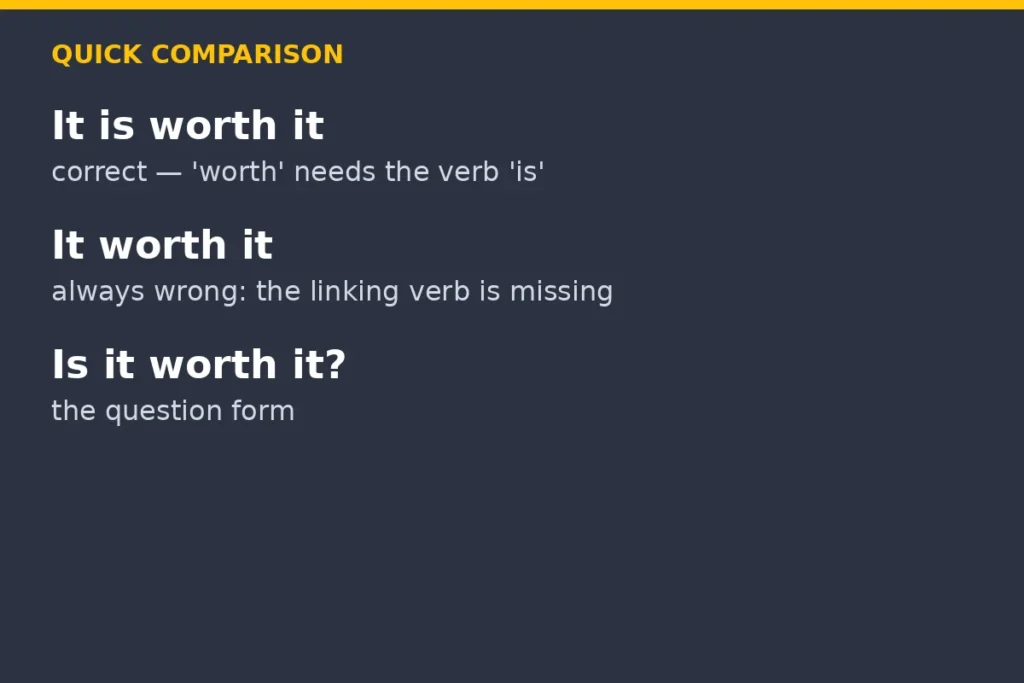
Quick Comparison: “It Worth It” vs “It Is Worth It”
| Form | Correct? | Why | Example |
|---|---|---|---|
| It is worth it | ✔ Yes | Has the linking verb “is” | It is worth it to try. |
| It’s worth it | ✔ Yes | Short form of “it is” | It’s worth it, trust me. |
| It worth it | ✗ No | The verb “is” is missing | — |
| Is it worth it? | ✔ Yes | Correct question form | Is it worth it to join? |
| Does it worth it? | ✗ No | “Worth” never follows “does” | — |
| It was worth it | ✔ Yes | Past tense of the phrase | The effort was worth it. |
| Worth it! (alone) | ✔ Informal | Reply only, when context is clear | “How was it?” — “Worth it!” |
Examples of “It Is Worth It” in Sentences
- The course is expensive, but it is worth it because you get a certificate.
- We waited two hours for the table, and the food made it worth it.
- Learning English takes time, but it is worth it for your career.
- Is it worth it to wake up at 5 a.m. to exercise? For your health, yes.
- The phone costs more, but the camera makes it worth it.
- Save a little money every month — it will be worth it one day.
- Don’t buy the cheapest bag; it isn’t worth it if it breaks in a week.
- He trained for a year, and winning the medal proved it was worth it.
“It Is Worth It” in Different Contexts
Study and Education
“Extra study hours felt hard, but passing the exam proved it was worth it.” Students use the phrase about courses, books, and degrees — anywhere effort now buys results later.
Work and Money
“The overtime was worth it because the bonus paid for our holiday.” At work, the phrase judges salaries, tools, and investments: “This software is worth it; it saves the team five hours a week.”
Health and Fitness
“Daily workouts were tiring, yet better health made them worth it.” The cost is effort and sore muscles; the value is energy and health.
Shopping and Travel
“This jacket is worth it — it has lasted five winters.” Travellers say it about long journeys: “The flight was long, but the island was worth it.”
Formal Writing
“It is worth it” is acceptable in most writing, but formal and professional texts often prefer alternatives: beneficial, worthwhile, cost-effective, or justified. Casual alternatives include “a good deal” and “it paid off.”
“Worth” vs “Worthy”: What Is the Difference?
These two words look similar but do different jobs:
- Worth talks about value: “This book is worth reading.” “The car is worth $5,000.”
- Worthy means deserving: “She is worthy of respect.” “He is a worthy winner.”
“Worthy” usually needs “of” after it (worthy of praise, worthy of trust), while “worth” is followed by a price, an -ing verb, or the word “it.” They are not interchangeable: ✗ “This book is worthy reading” is wrong; ✔ “This book is worth reading.”
Choosing between two similar forms is a common English problem — our guide to neither vs either solves another famous choice in the same simple way.
Why People Confuse These Forms
Three habits cause this mistake. First, fast typing: in chats and comments, small words like “is” often get dropped, and the shortcut starts to look normal. Second, casual speech: native speakers say “worth it” alone in replies, so learners copy the short reply into full sentences. Third, first-language patterns: in some languages, sentences do not need a linking verb (“it worth it” translates word-for-word from them), so learners must build a new habit in English. The fix is awareness: in English, the verb is never optional.
Common Mistakes to Avoid
- Dropping “is”: ✗ “It worth it to try.” → ✔ “It is worth it to try.”
- Using “does”: ✗ “Does it worth it?” → ✔ “Is it worth it?”
- Inventing “worthed”: ✗ “The trip worthed it.” → ✔ “The trip was worth it.” (“Worthed” is not an English word.)
- Stopping at “is it worth”: ✗ “Is it worth?” → ✔ “Is it worth buying?” or “Is it worth it?”
- Mixing “worth” and “worthy”: ✗ “She is worth of respect.” → ✔ “She is worthy of respect.”
- Using “worth it” alone in formal writing: A bare “Worth it” is a spoken reply, not a sentence. In reports and essays, write the full form or a formal alternative.
Tricks to Remember
- The bridge test: “Worth” cannot jump from “it” to the end of the sentence by itself — it needs the bridge “is.” No bridge, no sentence.
- Say the pattern aloud: “It — is — worth — it.” Four beats. If you hear only three, the verb is missing.
- The question check: If you can ask “Is it worth it?”, then the statement must contain the same “is”: “It is worth it.”
- Only “be” changes: is → was → will be. “Worth” itself never changes, so never write “worthed.”
Self-Check Quiz
- Choose the correct sentence: (a) “It worth it to learn English.” (b) “It is worth it to learn English.”
- Choose the correct question: (a) “Does it worth it?” (b) “Is it worth it?”
- Fill in the blank: “The training was hard, but it ___ worth it.” (is / was)
- True or false: “Worthed” is the past tense of “worth.”
- Fix the sentence: “Is worth it to buy this phone?”
- Choose: “She is ___ of our trust.” (worth / worthy)
Answers: 1. (b) — the linking verb “is” is required. 2. (b) — “worth” works with “is,” never “does.” 3. was — the training is finished, so use the past. 4. False — say “was worth it.” 5. “Is it worth it to buy this phone?” 6. worthy — “worthy of” means deserving.
Frequently Asked Questions
What is correct: “it worth it” or “it is worth it”?
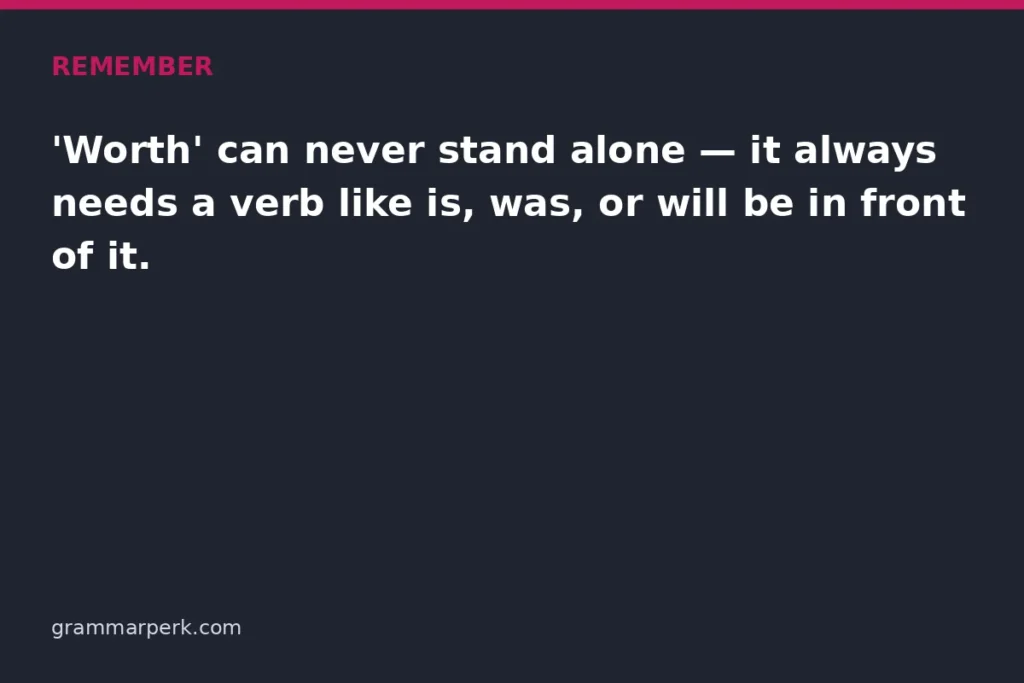
“It is worth it” is correct. “It worth it” is missing the linking verb “is,” which makes the sentence incomplete. In English, “worth” cannot act as a verb, so the sentence always needs is, was, or will be.
Can I say just “worth it”?
Yes, in casual speech and friendly messages, when the situation is clear: “Was the movie good?” — “Worth it!” In full sentences, formal writing, and exams, always use the complete form: “It is worth it.”
Is “does it worth it” correct?
No. “Worth” is not an action verb, so it never follows do or does. The correct question is “Is it worth it?”
What is the past tense of “it is worth it”?
Say “It was worth it.” Only the verb “be” changes (is → was). There is no word “worthed,” and “worth” itself never changes form.
What is the difference between “worth it” and “worthy”?
“Worth it” means something has enough value to justify its cost or effort. “Worthy” means deserving and is usually followed by “of”: “worthy of respect.” Value versus deserving — they cannot replace each other.
Can “it is worth it” be used in formal writing?
Yes, it is grammatically correct everywhere. However, professional writing often prefers alternatives such as beneficial, worthwhile, cost-effective, or justified, because they sound more precise.
Final Conclusion
The rule could not be simpler: English needs the verb. “It is worth it” is the only correct statement form, because “is” links “it” to its value; “it worth it” drops that verb and breaks the sentence. Ask “Is it worth it?”, look back with “It was worth it,” and save the short “Worth it!” for casual replies. Remember that “worth” shows value, “worthy” shows deserving, and “worthed” does not exist. Keep the little bridge word “is” in place, and this phrase will always be — quite literally — worth it.